
Product Overview
DG200D-E092E1-01 is an EC centrifugal fan with a 115 Vac input, delivering 1050 m³/h at up to 350 Pa, 120 W, 1000 r/min, 59 dB(A). Used in AHUs, fan coils, range hoods, air purifiers and ERV units. USD 55–180 FOB Nansha, MOQ 96 pcs, 25–30 days.
- Compact industrial housing (IP54)
- Long-life NSK ball bearings
Selection notes
DG200D-E092E1-01 belongs to the DG200 range: a EC centrifugal fan rated 115 V AC, 1050 m³/h at up to 350 Pa, 1000 r/min. Speed is set through 0-10V/PWM, 0-6.5V, 4-speed; the datasheet sound pressure is 59 dB(A).
Duty point: 1050 m³/h at 350 Pa. Because speed can be trimmed through 0-10V/PWM, 0-6.5V, 4-speed, the same unit can be re-set on site if the measured system resistance differs from the design value. For the destination market the grid is typically 110–240 V, 50/60 Hz, with CE, UL/ETL or CCC depending on destination as the compliance framework.
Technical Specifications
| Category | Centrifugal Fan |
|---|---|
| Model | DG200D-E092E1-01 |
| Motor Type | EC |
| Airflow | 1050 m³/h |
| Max Static Pressure | 350 Pa |
| Voltage | 115 V AC |
| Power | 120 W |
| Current | 1 A |
| Speed | 1000 r/min |
| Noise | 59 dB(A) |
| Protection Class | IP54 |
| Working Temperature | -25 °C ~ +50 °C |
| Impeller Material | PP+GF |
| Bearing Type | NSK ball bearing |
| Speed Control | 0-10V/PWM, 0-6.5V, 4-speed |
Data updated 2026-10
Ordering Information
| MOQ (Min. Order Qty) | 96 PCS |
|---|---|
| FOB Price | FOB Nansha Guangzhou |
| Reference price | US$55–180 |
| Lead Time | 25-30 days |
| Sample | Sample available |
| Payment Terms | TT |
| Shipping Port | Nansha Guangzhou OR Yantian Shenzhen |
Other Models in This Series
Performance Curves
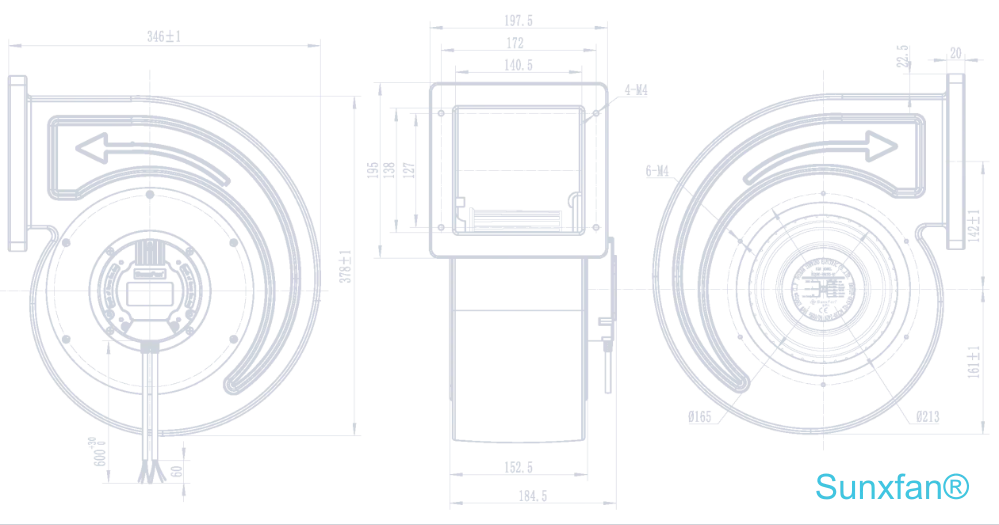
Dimensions (No.1)
Special Remarks
Impeller material options: galvanized sheet or PP
Applications
200 mm single-inlet blowers, 1,050–1,300 m³/h at 305–500 Pa, in EC (115/230 V AC) and 310 V DC builds. The DC version taps the rectified mains bus of inverter appliances — heat pumps, dehumidifiers — with no extra power supply. IP54.
Product dataSheets (PDF Download)
View Product dataSheets (PDF) PDF · EC·Centrifugal fan:DG200D-E092E1-01 Product dataSheetsFrequently Asked Questions
What is the difference between 310V DC and 230V AC input for industrial EC blowers?
The fundamental difference lies in where the AC-to-DC power conversion occurs: 230V AC EC blowers integrate rectifiers and power factor correction (PFC) directly inside the motor housing for plug-and-play grid connection, while 310V DC blowers accept direct DC bus power from a centralized supply, streamlining onboard motor electronics and reducing internal motor heat. | **Feature / Metric** | **230V AC Input EC Blower** | **310V DC Input EC Blower** | | --- | --- | --- | | **Power Source** | Single-phase AC grid (200–240V AC, 50/60 Hz) | Centralized DC bus, DC rectifier rack, or high-voltage battery array (nominal 310V DC, range ~280–380V DC) | | **Onboard Rectification** | Integrated AC-to-DC rectifier, PFC, and EMC filter stage | Omitted; direct connection to the internal DC bus driving the inverter bridge | | **Motor Drive Complexity** | Higher component count and larger PCB footprint inside the motor | Minimal PCB footprint; simplified drive electronics | | **Thermal Performance** | AC-to-DC conversion losses generate extra heat inside the motor housing | Cooler motor operation; conversion heat is dissipated at the central power supply | | **System Architecture** | Ideal for independent, standalone fan installations | Ideal for multi-fan arrays (Fan Walls / Grids) sharing a central DC power unit | | **Harmonics & EMC** | Filtered individually at each fan unit | Filtered centrally at the main AC-to-DC power supply stage | | **Primary Applications** | General HVAC, Air Handling Units (AHUs), standalone cooling | Data centers, central cooling walls, telecom racks, DC microgrids | System Design Note: Selecting 230V AC simplifies wiring for standalone equipment by eliminating external power supplies, whereas 310V DC is preferred in high-density fan arrays to maximize motor reliability, reduce internal motor operating temperatures, and centralize power management.