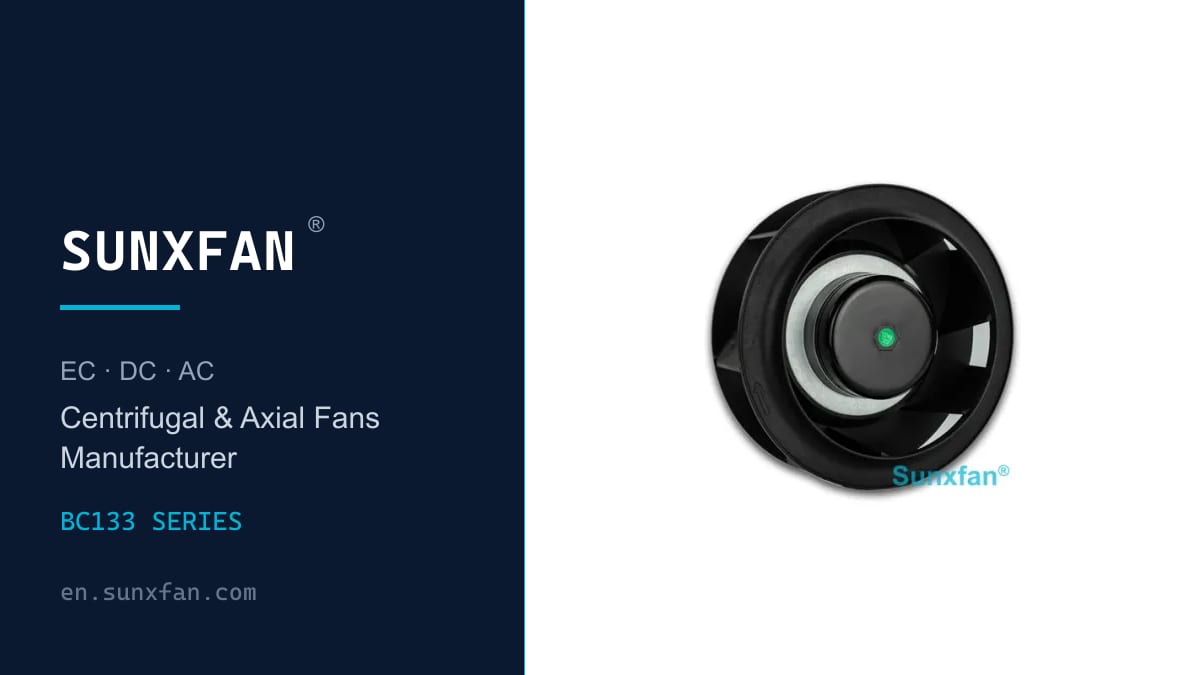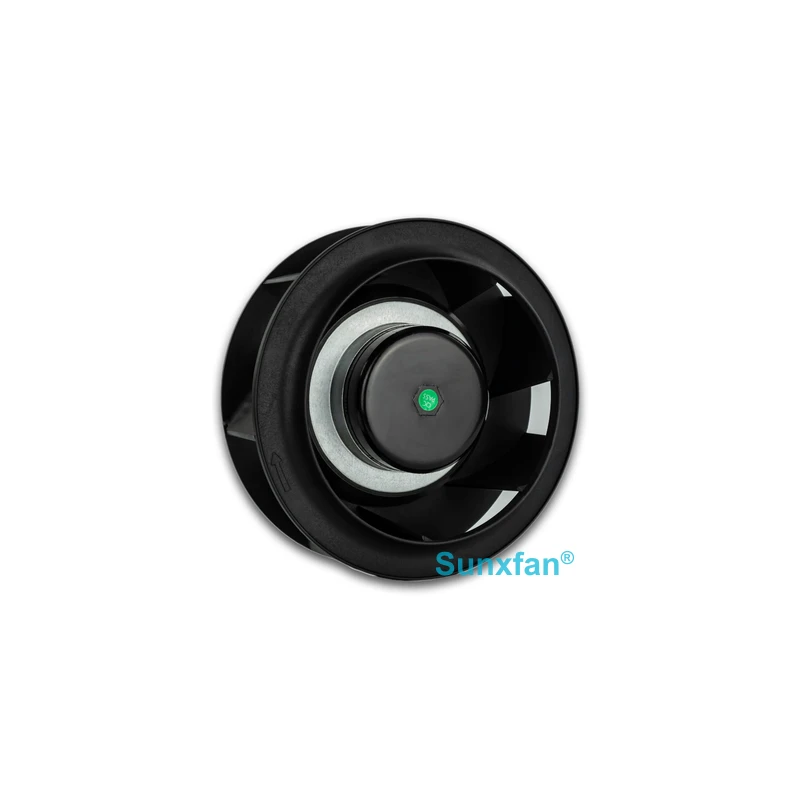
Centrifugal Fan
BC133 Series — Backward-Curved Centrifugal Fans

Applications
Compact 133 mm backward-curved EC centrifugal fans that deliver 450–480 m³/h at 500–580 Pa — high pressure from a palm-sized frame. Duty: dense electronics cabinets, laser and power-supply cooling, compact air curtains. 115/230 V AC, 0-10V/PWM and 3-speed, IP54.
Selection notes
The BC133 range covers 4 models between 450–480 m³/h, with static pressure up to 580 Pa. Motor options are EC; speed is set through 0-10V/PWM, 3-speed.
For system design this means one construction principle across the whole envelope, so installations with a similar air demand can be resolved without switching fan family. For the destination market the grid is typically 110–240 V, 50/60 Hz, with CE, UL/ETL or CCC depending on destination as the compliance framework.
| Model | Voltage | Power | Airflow | Noise | Speed Control | View Details |
|---|---|---|---|---|---|---|
| BC133A-E072A1-01 | 115 V AC | 50 W | 450 m³/h | 74 dB(A) | 0-10V/PWM, 3-speed | |
| BC133A-E072A3-01 | 230 V AC | 50 W | 450 m³/h | 74 dB(A) | 0-10V/PWM, 3-speed | |
| BC133A-E072D1-01 | 115 V AC | 50 W | 450 m³/h | 74 dB(A) | 0-10V/PWM, 3-speed | |
| BC133A-E072D3-01 | 230 V AC | 70 W | 480 m³/h | 76 dB(A) | 0-10V/PWM, 3-speed |
Compare Models
Select up to 4 models to compare detailed specifications. Each parameter row is color-coded.
FAQ
BC133A-E072A1-01
Forward-curved or backward-curved centrifugal — which one fits my duty?
Forward-curved (squirrel-cage) wheels are compact and cheap, but they peak at low pressure and their power keeps rising with airflow.
Forward-curved (squirrel-cage) wheels are compact and cheap, but they peak at low pressure and their power keeps rising with airflow. Backward-curved wheels like the BC133’s sustain higher static pressure (500–580 Pa here), hold efficiency over a wider band, and their power curve is non-overloading. Rule of thumb: above roughly 300 Pa of system resistance, or continuous duty, favors backward-curved.
How do I find the actual operating point from the fan curve?
Draw your system curve — resistance rises with the square of airflow (P = k·Q²) — and lay it over the fan’s P-Q curve.
Draw your system curve — resistance rises with the square of airflow (P = k·Q²) — and lay it over the fan’s P-Q curve. The intersection is the operating point; check it sits to the right of the fan’s pressure peak, where the curve is steep and stable. Then read power and noise at that point, not at the catalogue maximum.
Can I drive the EC version straight from a room thermostat or BMS?
Yes. The EC input takes 0-10V or PWM — map it to whatever the controller outputs: a simple thermostat gives high/low, a BMS gives full modulation.
Yes. The EC input takes 0-10V or PWM — map it to whatever the controller outputs: a simple thermostat gives high/low, a BMS gives full modulation. Set a minimum-speed floor so the fan never stalls or hunts at tiny signals; below about 20% command most systems gain nothing but noise and heat.