Centrifugal Fan
BC310 Series — Backward-Curved Centrifugal Fans

Applications
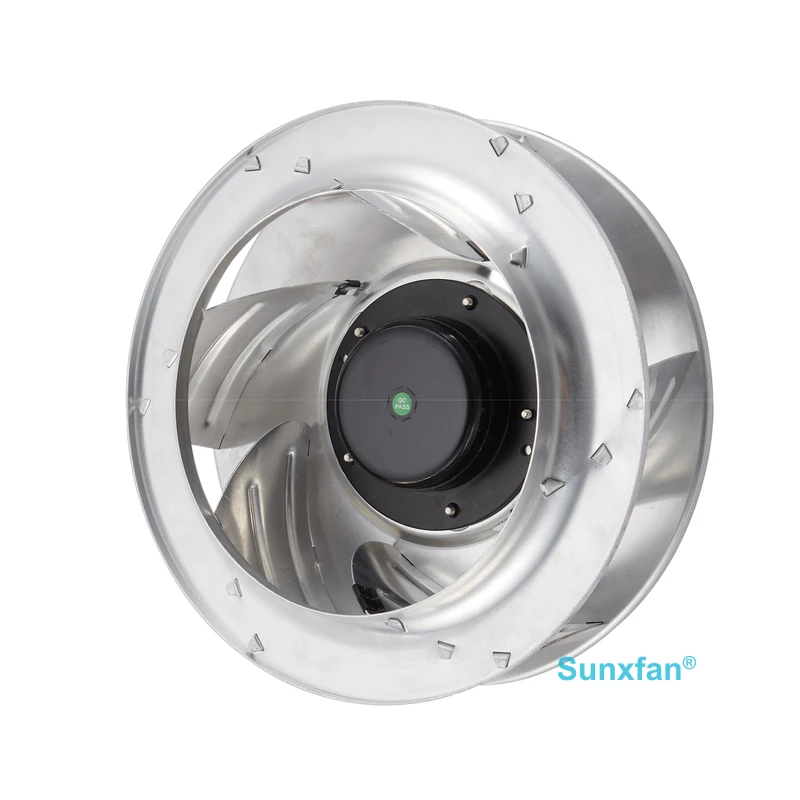
The largest SUNXFAN EC centrifugal frame: 1,750–2,500 m³/h at 615–715 Pa with a riveted aluminum impeller. Built for central AHU modules, large FFU arrays and process cooling. 115/230 V AC, 0-10V/PWM and Modbus RTU, IP54.
Selection notes
The BC310 range covers 5 models between 1750–2500 m³/h, with static pressure up to 715 Pa. Motor options are EC; speed is set through 0-10V/PWM, Modbus RTU(RS485).
For system design this means one construction principle across the whole envelope, so installations with a similar air demand can be resolved without switching fan family. For the destination market the grid is typically 110–240 V, 50/60 Hz, with CE, UL/ETL or CCC depending on destination as the compliance framework.
| Model | Voltage | Power | Airflow | Noise | Speed Control | View Details |
|---|---|---|---|---|---|---|
| BC310A-E092D1-01 | 115 V AC | 160 W | 1950 m³/h | 64 dB(A) | 0-10V/PWM, Modbus RTU(RS485) | |
| BC310A-E092D3-01 | 230 V AC | 160 W | 2100 m³/h | 64 dB(A) | 0-10V/PWM, Modbus RTU(RS485) | |
| BC310A-E092E3-02 | 230 V AC | 240 W | 2500 m³/h | 74 dB(A) | 0-10V/PWM, Modbus RTU(RS485) | |
| BC310B-E092E1-01 | 115 V AC | 175 W | 1750 m³/h | 71 dB(A) | 0-10V/PWM, Modbus RTU(RS485) | |
| BC310B-E092E3-01 | 230 V AC | 175 W | 2500 m³/h | 71 dB(A) | 0-10V/PWM, Modbus RTU(RS485) |
Compare Models
Select up to 4 models to compare detailed specifications. Each parameter row is color-coded.
FAQ
BC310A-E092E3-02
EC Backward Curved Centrifugal Fan,100-3500 m³/h,Impeller size: 133-355mm,What industry and specific equipment is this type of fan mainly used for?
HVAC air handling, cleanroom and data-centre cooling, and industrial process ventilation that needs high static pressure in a compact footprint.
EC backward-curved centrifugal fans in the 133-355mm (100-3500 m³/h) range are the high-efficiency workhorses for systems demanding high static pressure, space-saving footprints, and precise airflow control.
These fans typically utilize an external rotor motor design, where the electronically commutated (EC) motor is nested directly inside the impeller hub. This eliminates the need for an external motor shaft and drive belt, drastically reducing the physical footprint. Their backward-curved blades have a "non-overloading" power characteristic, meaning the motor will not burn out even if the system pressure drops suddenly.
Because of their ability to push air through high-resistance pathways while maintaining energy efficiency, they are primarily integrated into the following industrial and commercial equipment:
| Industry | Specific Equipment | Core Function & Advantage |
|---|---|---|
| HVAC & Air Purification | Heat Recovery Ventilation (HRV), Air Handling Units (AHU), Commercial Purifiers | Pushes high volumes of air through dense HEPA filters and complex ductwork. The backward-curved design prevents stalling under high filter resistance. |
| Smart Agriculture & CEA | Containerized Plant Factories, Greenhouse Climate Control | Overcomes the high static pressure created by dense, multi-tier plant canopies (such as high-density tomato or strawberry racks). The EC motors easily integrate with Modbus/MQTT sensor networks for automated, recipe-driven climate control. |
| Precision Cooling & IT | Data Center CRAC units, Telecom Cabinets, Server Rack Exhausts | Provides continuous, high-reliability cooling. The EC motor's stepless speed control responds dynamically to thermal loads, saving significant energy during off-peak hours. |
| Cleanroom Technology | Fan Filter Units (FFU), Biological Safety Cabinets, Clean Benches | Delivers stable, uniform laminar airflow across strict filtration barriers while adhering to stringent European and international energy efficiency directives. |
| Industrial Automation | Inverter Cabinets, CNC Machine Cooling, High-Power UPS Systems | Efficiently extracts waste heat from densely packed electrical enclosures where the compact outer-rotor profile maximizes available cabinet space. |
The 100 to 3500 m³/h airflow range perfectly covers the transition from high-end residential systems (like whole-house ventilation) up to medium-scale industrial machinery, making this specific size bracket one of the most widely specified components in modern air handling.
Why a riveted aluminium impeller at this size?
Riveting keeps every blade where it was fabricated at high tip speed, lowers start-up inertia through aluminium's low density, and lets single blades be replaced in service.
Because it keeps the balance honest at speed. Riveting avoids the distortion welding introduces — every blade stays where it was fabricated, which matters when the wheel pushes 715 Pa at high tip speed. Aluminium brings the strength-to-weight ratio (roughly a third of steel’s density), so start-up inertia and bearing loads stay civil, and individual blades can be replaced in service instead of scrapping the wheel.
Is this fan a drop-in upgrade for an AC installation?
On the same 230 V mains it draws less current at duty — 240 W for 2,500 m³/h — and adds 0-10V/PWM control where an old AC motor ran flat out.
On the same 230 V mains it draws less current at duty — 240 W for 2,500 m³/h — and adds 0-10V/PWM control where an old AC motor ran flat out. Before swapping, verify three things: the physical envelope and mounting against the old motor-impeller assembly, the acoustic change you will hear at partial speed (quieter), and where the control signal comes from — tie it to full speed if no controller exists. On continuous duty the energy saving usually repays the retrofit within the first year.