
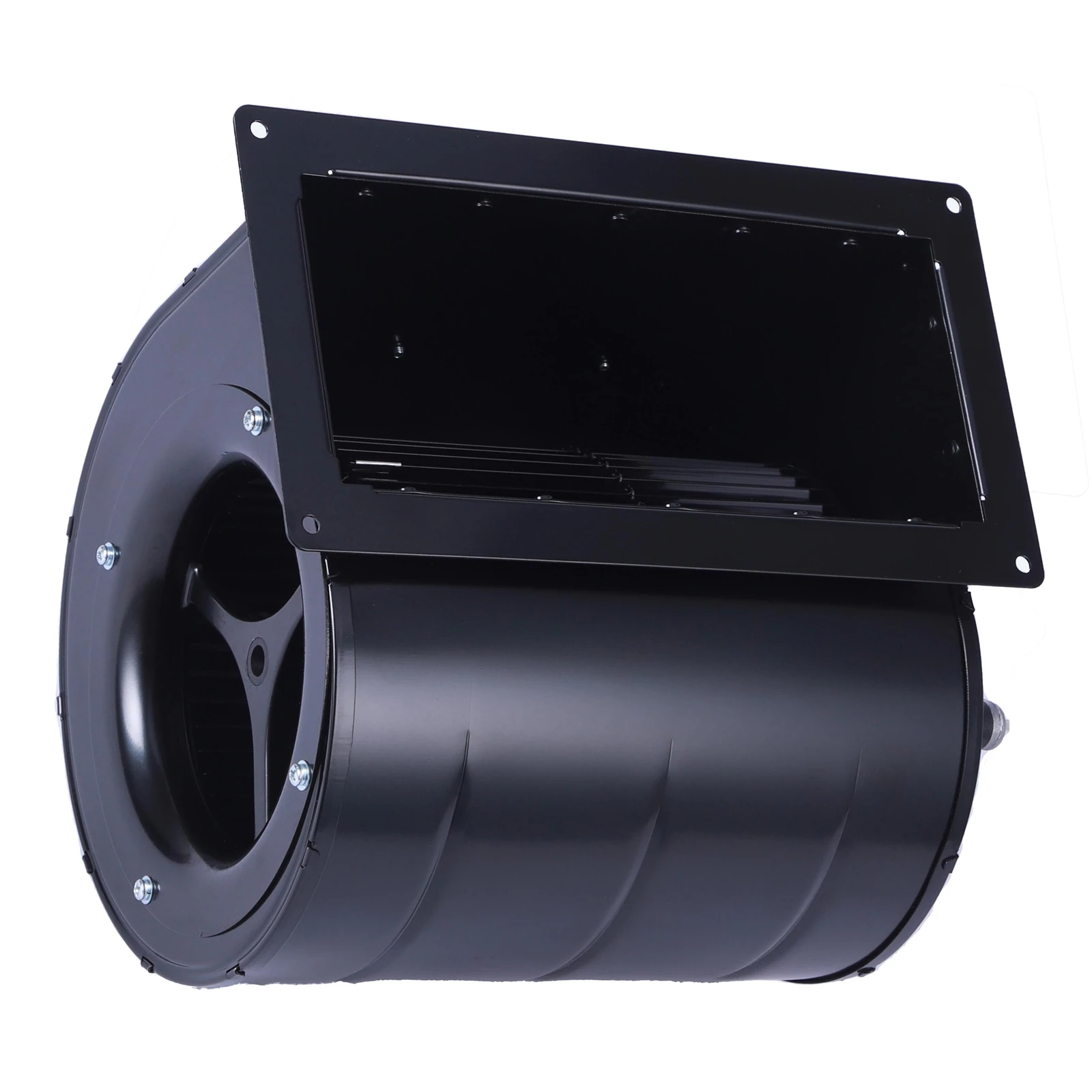
Product Overview
SF133A-E092A1-01 is an EC centrifugal fan with a 115 Vac input, delivering 1150 m³/h at up to 485 Pa, 125 W, 1800 r/min, 66±2 dB(A). Used in AHUs, fan coils, range hoods, air purifiers and ERV units. USD 42–85 FOB Nansha, MOQ 80 pcs, 25–30 days.
- Compact industrial housing (IP54)
- Long-life NSK ball bearings
Selection notes
SF133A-E092A1-01 belongs to the SF133A range: a EC centrifugal fan rated 115 V AC, 1150 m³/h at up to 485 Pa, 1800 r/min. Speed is set through 0-10V/PWM, 0-5V, 0-6.5V, 4-speed; the datasheet sound pressure is 66±2 dB(A).
Duty point: 1150 m³/h at 485 Pa. Because speed can be trimmed through 0-10V/PWM, 0-5V, 0-6.5V, 4-speed, the same unit can be re-set on site if the measured system resistance differs from the design value. For the destination market the grid is typically 110–240 V, 50/60 Hz, with CE, UL/ETL or CCC depending on destination as the compliance framework.
Technical Specifications
| Category | Centrifugal Fan |
|---|---|
| Model | SF133A-E092A1-01 |
| Motor Type | EC |
| Airflow | 1150 m³/h |
| Max Static Pressure | 485 Pa |
| Voltage | 115 V AC |
| Power | 125 W |
| Current | 1.1 A |
| Speed | 1800 r/min |
| Noise | 66±2 dB(A) |
| Protection Class | IP54 |
| Working Temperature | -25 °C ~ +60 °C |
| Impeller Material | Galvanised sheet steel |
| Bearing Type | NSK ball bearing |
| Speed Control | 0-10V/PWM, 0-5V, 0-6.5V, 4-speed |
Data updated 2026-10
Ordering Information
| MOQ (Min. Order Qty) | 80 PCS |
|---|---|
| FOB Price | FOB Nansha Guangzhou |
| Reference price | US$42–85 |
| Lead Time | 25-30 days |
| Sample | Sample available |
| Payment Terms | TT |
| Shipping Port | Nansha Guangzhou OR Yantian Shenzhen |
Other Models in This Series
Performance Curves
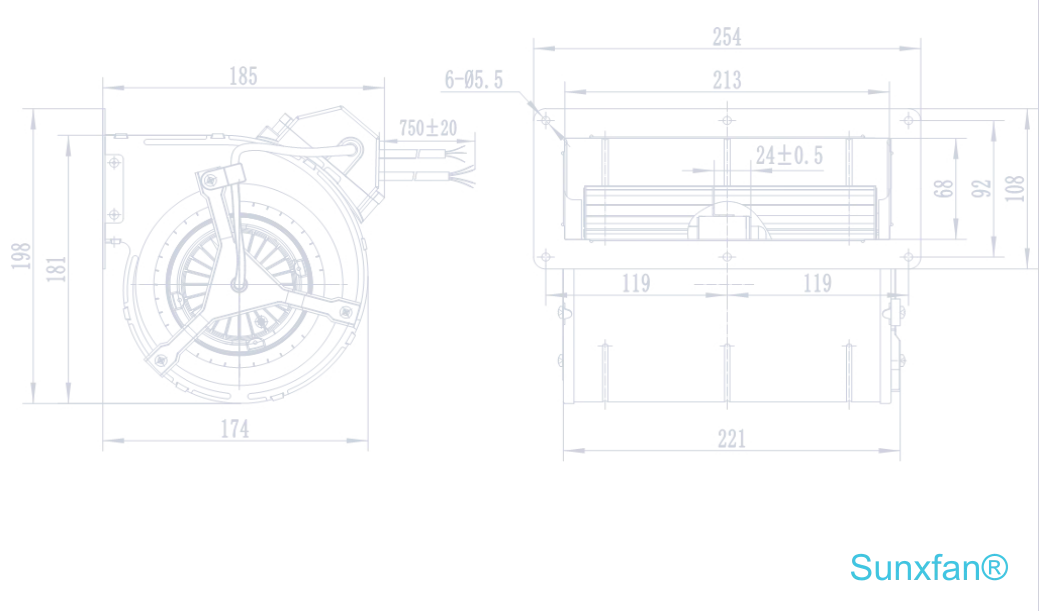
Dimensions
Special Remarks
[Optional] Housing and impeller material: galvanized steel plate + electrophoretic black.
Applications
133×133 mm dual-inlet EC blowers delivering 1,150 m³/h at 485 Pa — the airflow of a much larger wheel in an ultra-flat format for slim air curtains, wall-mounted ERVs and underfloor fan coils. 115/230 V AC or 310 V DC, IP54.
Product dataSheets (PDF Download)
View Product dataSheets (PDF) PDF · EC·Centrifugal fan:SF133A-E092A1-01 Product dataSheetsFrequently Asked Questions
Why choose EC fans over AC fans?
EC fans (electronically commutated fans) are generally chosen over AC fans when you want higher efficiency, precise speed control, lower noise, and smarter system integration. They cost more upfront, but often win on total cost of ownership. Core difference AC fan: an AC induction/shaded-pole/PSC motor connected directly to mains. Speed is usually fixed or controlled crudely by voltage/frequency. EC fan: a brushless DC/PMSM motor with integrated electronics. It accepts AC mains, converts it internally to DC, and uses electronic commutation. Speed can be controlled smoothly via 0–10 V, PWM, Modbus, BACnet, etc. Why choose EC fans Area EC fan advantage Energy efficiency Much higher efficiency, especially at partial load. Often equivalent to IE4/IE5 motor efficiency. Can use 20–50% less energy than comparable AC fans in variable-load applications. Speed control Built-in wide-range speed control. No separate VFD needed. Easy to match airflow to actual demand. Part-load savings Fan power follows the affinity laws: reducing speed to 80% can cut power to about 50%. EC fans exploit this far better than AC fans. Noise Lower noise and vibration, especially at reduced speed. Useful in HVAC, refrigeration, data centers, and residential equipment. Power quality High power factor, often >0.9, and lower starting current. Soft start reduces inrush and mechanical stress. Integration Can include onboard sensors, alarms, fault reporting, and digital communication. Fits smart buildings and IoT systems. Compactness Integrated motor + control saves space and wiring compared with an AC motor plus external VFD. Reliability/maintenance Fewer wearing parts, long life, and lower maintenance in clean environments. Compliance Helps meet tightening efficiency rules such as EU ErP/IE4/IE5, carbon-footprint targets, and RoHS/REACH requirements. Total cost of ownership Higher purchase price, but lower energy bills, rebates, and reduced maintenance can pay back quickly in continuous-duty applications. When AC fans may still be better Very low-cost, short-life, or simple on/off applications. Harsh environments: high ambient temperature, dirty power, heavy vibration, or aggressive contamination can stress EC electronics. Fixed full-speed operation where energy savings are small. Sites with easy AC motor repair and no need for smart control. Explosive or specialty environments where a certified EC solution is unavailable or too expensive. Bottom line Choose EC fans when the fan runs for long hours, operates at variable load, needs precise airflow/temperature control, must be quiet, or must meet modern efficiency and carbon requirements. Choose AC fans when upfront cost and extreme simplicity/robustness matter more than energy and controllability. For most modern HVAC, refrigeration, data-center, and ventilation systems, EC fans are the better long-term choice.