
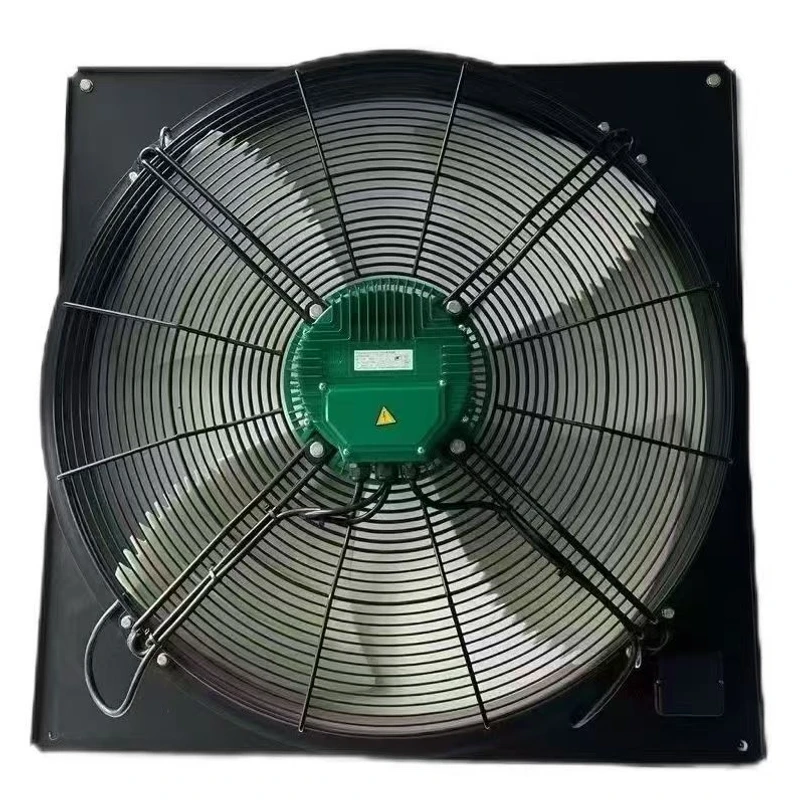
Product Overview
AS910A-E150A3-01 is an EC axial fan with a 380–480 Vac input, delivering 25000 m³/h at up to 300 Pa, 1800 W, 930 r/min, 73 dB(A). Used in condensers, dry coolers, cooling towers and switchgear cabinets. USD 300–700 FOB Nansha, MOQ 70 pcs, 25–30 days.
- Compact industrial housing (IP55)
- Long-life ball bearings
With guard-ring or fan-ring mounting, AS axial fans are also specified for cooling towers and dry coolers, where high airflow at low static pressure and weather-resistant construction matter most.
Selection notes
AS910A-E150A3-01 belongs to the AS Axial-Fan Integrated Guard Ring range: a EC centrifugal fan rated 380-480 V AC, 25000 m³/h at up to 300 Pa, 930 r/min. Speed is set through 0-10V/PWM, Modbus RTU(RS485); the datasheet sound pressure is 73 dB(A).
Duty point: 25000 m³/h at 300 Pa. Because speed can be trimmed through 0-10V/PWM, Modbus RTU(RS485), the same unit can be re-set on site if the measured system resistance differs from the design value. For the destination market the grid is typically 110–240 V, 50/60 Hz, with CE, UL/ETL or CCC depending on destination as the compliance framework.
Technical Specifications
| Category | Axial Fan |
|---|---|
| Model | AS910A-E150A3-01 |
| Motor Type | EC |
| Airflow | 25000 m³/h |
| Max Static Pressure | 300 Pa |
| Voltage | 380-480 V AC |
| Power | 1800 W |
| Current | 4.5 A |
| Speed | 930 r/min |
| Noise | 73 dB(A) |
| Protection Class | IP55 |
| Working Temperature | -40 °C ~ +65 °C |
| Impeller Material | PA6+GF30% |
| Bearing Type | ball bearing |
| Speed Control | 0-10V/PWM, Modbus RTU(RS485) |
Data updated 2026-10
Ordering Information
| MOQ (Min. Order Qty) | 70 PCS |
|---|---|
| FOB Price | FOB Nansha Guangzhou |
| Reference price | US$300–700 |
| Lead Time | 25-30 days |
| Sample | Sample available |
| Payment Terms | TT |
| Shipping Port | Nansha Guangzhou OR Yantian Shenzhen |
Other Models in This Series
Performance Curves
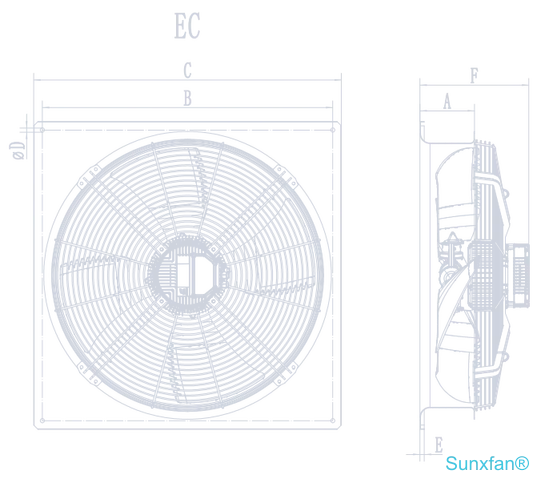
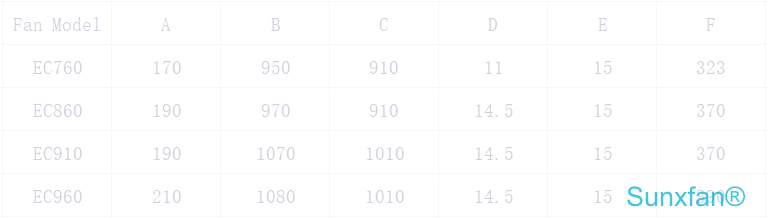
Dimensions
Special Remarks
Wall ring: Sheet,Electrophoresis and coated in Black matt plastic; Guard grille:Stell,Electrophoresis and coated in Black matt plastic;
Applications
Large EC axial fans (760–960 mm impeller, 380–480 V AC) with wall ring and guard for free-cooling walls, large AHUs and industrial air exchange. 16,500–29,000 m³/h per fan; 0-10V/PWM and Modbus RTU for plant integration. -40 °C to +65 °C operating window.
Product dataSheets (PDF Download)
View Product dataSheets (PDF) PDF · EC·Axial fan:AS910A-E150A3-01 Product dataSheetsFrequently Asked Questions
What are the primary applications of EC axial fans with a wall ring and guard?
For a massive EC axial fan with an operating voltage of 380–480V AC (three-phase industrial wide voltage), a maximum airflow of 31,000 m³/h, and equipped with a Wall Ring and Guard, this is an ultra-high-airflow, industrial-grade, high-efficiency heavy-duty fan (typically corresponding to a 760mm–1000mm large-diameter impeller class). The combination of 380–480V three-phase power with the stepless speed control and high energy efficiency of an EC motor makes it highly suitable for heavy industrial and agricultural scenarios requiring 24-hour continuous operation, ultra-large-space air exchange, or high heat dissipation loads. I. Specific Industries and Application Scenarios 1. Livestock & Agricultural Ventilation Large modern poultry houses and dairy barns: The ultra-high airflow of 31,000 m³/h is extremely suitable as tunnel ventilation fans at the end of large-scale farms, used to rapidly remove ammonia, moisture, and heat from the barn to maintain livestock comfort. Large multi-span greenhouses: Installed on the end wall of the greenhouse, working in conjunction with a Cooling Pad system for overall evaporative cooling and long-distance air circulation. 2. HVAC & Commercial Refrigeration Dry Coolers & Closed Cooling Towers: Widely used as top-mounted exhaust fans for dry coolers, serving heat dissipation in the secondary loop for data centers, large commercial buildings, or industrial refrigeration. Large Air-Cooled Condensers & Chillers: The design equipped with a Wall Ring and Guard allows direct bolt-fastening to the top or side of condenser frames, significantly improving heat exchange efficiency and reducing energy consumption. 3. Industrial Facilities & High-Bay Ventilation Heavy Industrial Plant Exhaust: Suitable for high-temperature/high-dust workshops in steel, foundry, chemical, rubber, and glass industries, installed on exterior walls for centralized high-power exhaust. Logistics Centers & Warehouses: Maintaining overall air movement within high-bay spaces to prevent hot air accumulation at the top (destratification). 4. Renewable Energy & Power Grid MW-level Containerized ESS: In centralized heat exhaust systems for large energy storage containers, secured to the container end wall via the Wall Ring for high-airflow forced draft cooling to prevent battery thermal runaway. Transformers & Wind Turbine Substation Cooling: Used for air-cooling systems of ultra-high-voltage transformer banks and heat dissipation of electrical equipment at the base of wind turbine towers.
One large fan or several smaller ones for the same duty?
One AS910 moving 25,000 m³/h beats a bank of small fans on installed cost, wiring and maintenance — one motor, one set of bearings to watch. It also wins the acoustic sum: several equal sources together add about 10·log(N) dB, so five fans of the same total duty run roughly 7 dB(A) louder than one. Several smaller fans earn their place where redundancy matters — N+1 capacity so a single failure costs a fraction of the airflow — and where the opening cannot host one round fan.
How does Modbus RTU integration work on this fan?
The EC electronics expose the fan as a Modbus RTU slave: the BMS writes the speed setpoint and reads back speed, current and status over the same two-wire RS-485 that already runs the site. That closes the thermal loop — airflow follows measured temperature instead of a fixed tap — and runtime logs enable condition-based maintenance instead of calendar-based. Address, baud and parity are configured once at commissioning; afterwards the fan behaves like any other Modbus device on the panel.