
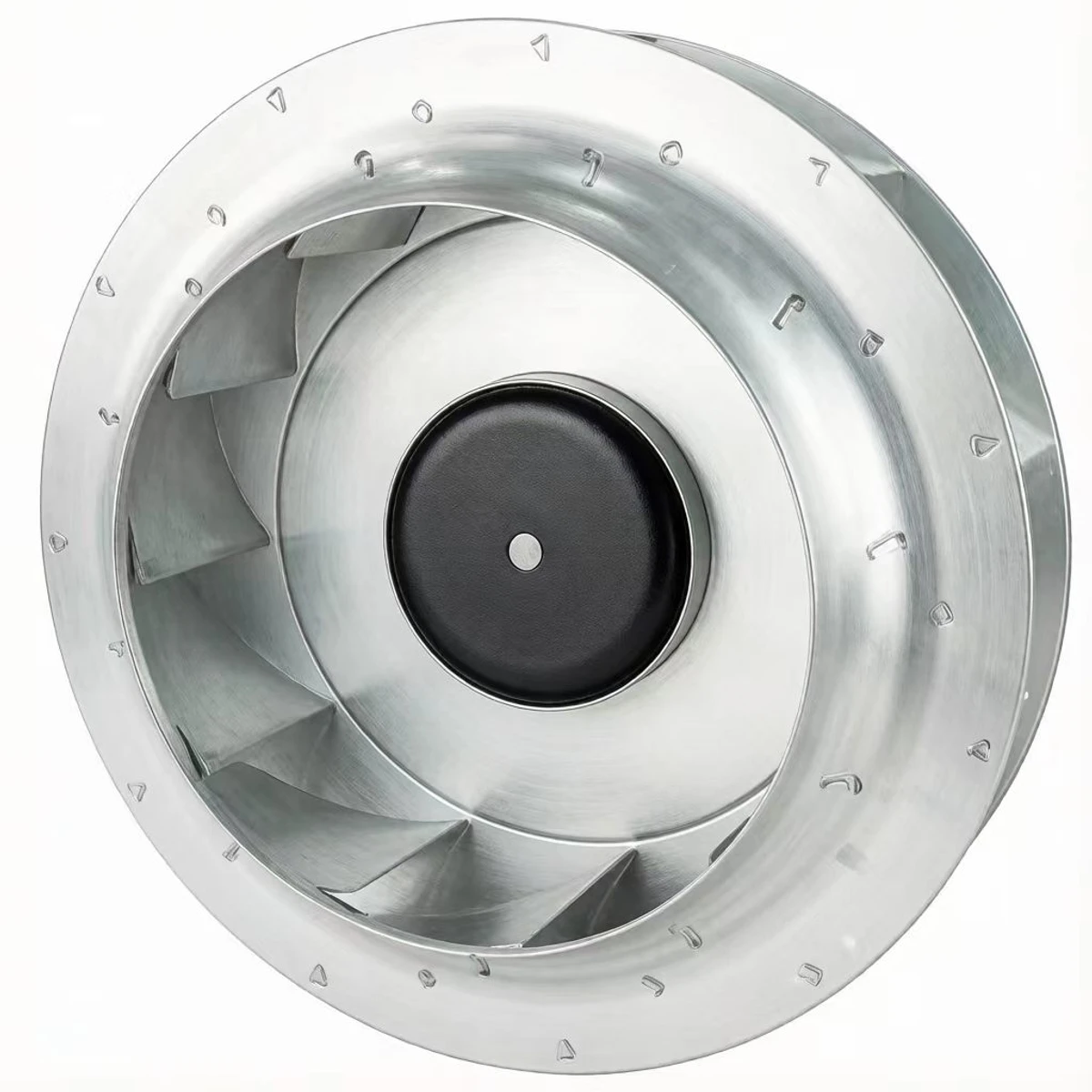
Product Overview
BC280B-E092E3-02 is an EC centrifugal fan with a 230 Vac input, delivering 2000 m³/h at up to 460 Pa, 200 W, 1700 r/min, 65 dB(A). Used in AHUs, fan coils, range hoods, air purifiers and ERV units. USD 60–145 FOB Nansha, MOQ 240 pcs, 25–30 days.
- Compact industrial housing (IP54)
- Long-life NSK ball bearings
Selection notes
BC280B-E092E3-02 belongs to the BC280 range: a EC centrifugal fan rated 230 V AC, 2000 m³/h at up to 460 Pa, 1700 r/min. Speed is set through 0-10V/PWM, Modbus RTU(RS485); the datasheet sound pressure is 65 dB(A).
Duty point: 2000 m³/h at 460 Pa. Because speed can be trimmed through 0-10V/PWM, Modbus RTU(RS485), the same unit can be re-set on site if the measured system resistance differs from the design value. For the destination market the grid is typically 110–240 V, 50/60 Hz, with CE, UL/ETL or CCC depending on destination as the compliance framework.
Technical Specifications
| Category | Centrifugal Fan |
|---|---|
| Model | BC280B-E092E3-02 |
| Motor Type | EC |
| Airflow | 2000 m³/h |
| Max Static Pressure | 460 Pa |
| Voltage | 230 V AC |
| Power | 200 W |
| Current | 0.87 A |
| Speed | 1700 r/min |
| Noise | 65 dB(A) |
| Protection Class | IP54 |
| Working Temperature | -25 °C ~ +60 °C |
| Impeller Material | Galvanized steel plate |
| Bearing Type | NSK ball bearing |
| Speed Control | 0-10V/PWM, Modbus RTU(RS485) |
Data updated 2026-10
Ordering Information
| MOQ (Min. Order Qty) | 240 PCS |
|---|---|
| FOB Price | FOB Nansha Guangzhou |
| Reference price | US$60–145 |
| Lead Time | 25-30 days |
| Sample | Sample available |
| Payment Terms | TT |
| Shipping Port | Nansha Guangzhou OR Yantian Shenzhen |
Other Models in This Series
Performance Curves
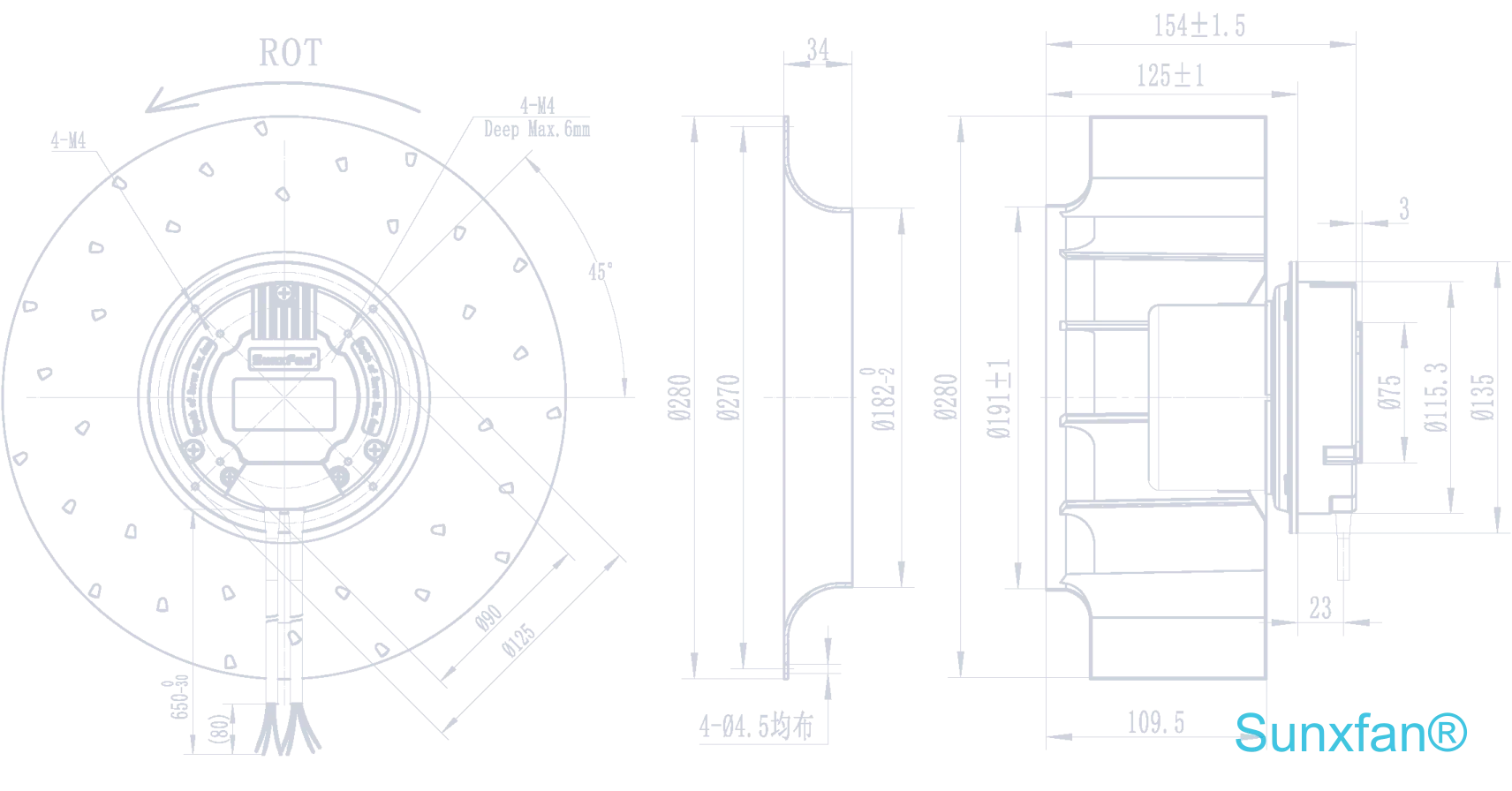
Dimensions (No.2)
Special Remarks
Impeller material: Galvanized steel plate (powder coating)
Applications
280 mm backward-curved EC centrifugal fans: 1,540–2,000 m³/h at 460–715 Pa for AHUs, ERVs and industrial cabinets. 0-10V/PWM plus Modbus RTU over RS485 for BMS integration. Powder-coated galvanized impeller, IP54, -25 °C to +60 °C.
Product dataSheets (PDF Download)
View Product dataSheets (PDF) PDF · EC·Centrifugal fan:BC280B-E092E3-02 Product dataSheetsFrequently Asked Questions
Forward-curved vs. backward-curved EC centrifugal fans: Which has higher aerodynamic efficiency?
**Backward-curved** EC centrifugal fans have significantly higher aerodynamic efficiency than forward-curved fans. The core difference lies in the blade geometry and how it converts kinetic energy into static pressure. ### The Efficiency Breakdown | Feature | Backward-Curved Fan | Forward-Curved Fan | | --- | --- | --- | | **Peak Aerodynamic Efficiency** | **Up to 75–85%** | Typically 55–65% | | **Blade Design** | Blades curve *away* from the direction of rotation. | Blades curve *into* the direction of rotation (like a scoop). | | **Energy Conversion** | Converts most of the mechanical energy directly into static pressure within the impeller itself. | Generates high air velocity (kinetic energy) which then requires a scroll housing to convert that velocity into static pressure. | | **Power Characteristic** | **Non-overloading:** Maximum power draw occurs near peak efficiency. Even if system resistance drops to zero (free air), the motor will not overload. | **Overloading:** Power draw increases as airflow increases. If system resistance drops, the fan will pull too much air and overload the motor. | --- ### When to Use Which? While backward-curved fans are more efficient, they require higher rotational speeds (RPM) to achieve the same airflow as a forward-curved fan, which can result in a different acoustic profile. * **Choose Backward-Curved:** When high efficiency, low energy consumption, and high static pressure are critical (e.g., HRV units, precision cooling, HEPA filtration systems, and large HVAC arrays). * **Choose Forward-Curved:** When lower operating speeds, quieter acoustics at lower pressures, and compact sizing are needed, and peak efficiency is less critical (e.g., residential fan coils, small air curtains).
Galvanized steel or PA6+GF25 impeller — what drives the choice?
Both materials are offered around this wheel size. Galvanized steel (this model, powder-coated) holds its balance at temperature and tolerates grease and solvent traces — kitchen extract and process air. PA6+GF25 is about half the density, so bearings and motor start gently, and it shrugs off the humidity and salt that eventually attack any coating. Rule of thumb: hot or chemically loaded air points to steel; humidity, salt air and weight-sensitive mounts point to polymer.