
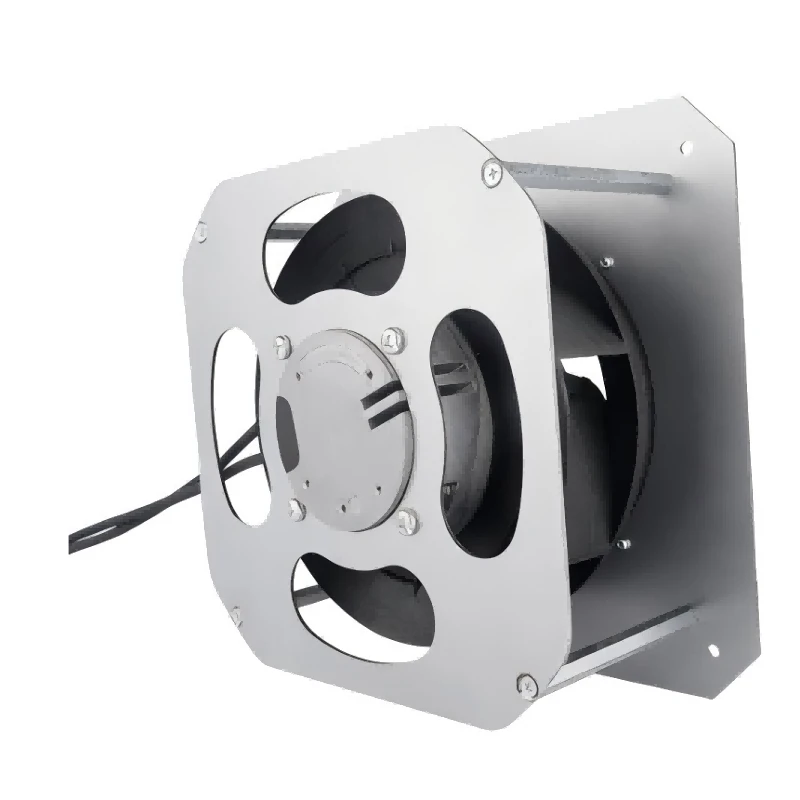
Product Overview
CF160-2000CFM-01 is an EC fan unit with a 110–254 Vac input, delivering 3400 m³/h at up to 720 Pa, 360W, 1950 r/min, 66 dB(A). Used in AHUs, ducted ventilation and ERV/HRV units. USD 60–6000 FOB Nansha, MOQ Open MOQ pcs, 25–30 days.
- 100–240 V single-SKU design — one part number for every region
- 0-10V/PWM, 4-speed or Modbus RTU (RS485) control, ready for CO₂-driven demand control
- 66 dB(A) at the rated point with a soft-start EC motor
- Rack-mount chassis, IP54, −25 °C to +60 °C
Typical installations: large classrooms and lecture theatres, canteens, and grow rooms needing higher air exchange with carbon filtration.
Technical Specifications
| Category | Fan Units |
|---|---|
| Model | CF160-2000CFM-01 |
| Motor Type | EC |
| Airflow | 3400 m³/h |
| Max Static Pressure | 720 Pa |
| Voltage | 110-254 VAC |
| Power | 360W |
| Current | 1.4–3.3 A |
| Speed | 1950 r/min |
| Noise | 66dB(A) |
| Protection Class | IP54 |
| Working Temperature | -25 °C ~ +60 °C |
| Impeller Material | PA+GF |
| Bearing Type | Ball Bearing |
| Speed Control | 0-10V/PWM, 4-speed, Modbus RTU(RS485) |
Data updated 2026-10
Ordering Information
| MOQ (Min. Order Qty) | Open MOQ |
|---|---|
| FOB Price | FOB Nansha Guangzhou |
| Reference price | US$60–6000 |
| Lead Time | 25-30 days |
| Sample | Sample available |
| Payment Terms | TT |
| Shipping Port | Nansha Guangzhou OR Yantian Shenzhen |
Other Models in This Series
Performance Curves
Dimensions

Special Remarks
"Larger rack-mount variant of the CF146 family; 0-10V/PWM, 4-speed or Modbus RTU (RS485); CO₂/temperature/humidity sensor input for demand-controlled ventilation."
Applications
EC blowers on a 110–254 V universal mains input — one SKU for every region. 1,100–3,450 m³/h at ~700 Pa for heat-recovery ventilators, ERV/HRV cores and greenhouse air distribution. Soft-start EC motor, 0-10V/PWM or 4-speed, IP54, 56–66 dB(A).
Product dataSheets (PDF Download)
View Product dataSheets (PDF) PDF · EC·Fan unit:CF160-2000CFM-01 Product dataSheetsFrequently Asked Questions
Comparison of the pros and cons of four types of fans (Inline, Oscillating, Clip-on, Centrifugal fan) in the hydroponic growing industry?
Inline fans are best suited for overall exhaust in grow tents or rooms, delivering a good balance of airflow (CFM) and medium static pressure with easy installation in ductwork. However, their performance drops when facing high resistance (such as carbon filters), so they are typically connected to carbon filters and ductwork as the primary exhaust solution. 2. Oscillating Fan: Canopy Circulation, coverage area, gentle airflow, wide coverage, breaks leaf boundary layer, simulates natural wind, dispersed airflow, cannot be used for long-distance exhaust, canopy circulation in medium to large grow spaces, prevents localized temperature and humidity imbalances. 3. Clip-on Fan: Targeted Airflow, flexibility, adjustable airflow, compact size, flexible installation, low energy consumption; concentrated airflow, limited coverage, only suitable for localized circulation, small tents, propagation areas, mother plant areas, or as supplementary circulation in large spaces. 4. EC Centrifugal Fan: High Static Pressure, high static pressure, extremely high static pressure, can push air through complex ductwork and filters; compact size, low power consumption, suitable for large-scale commercial cultivation, multi-layer vertical farms, long duct runs, or high-density carbon filter systems.
How can Inline, Oscillating, Clip-on, and Centrifugal fans be comprehensively combined for use in retrofitting indoor growing facilities?
A high-performance EC Inline or EC Centrifugal Fan Unit should be used as the primary exhaust fan, responsible for air exchange throughout the entire space. Use one or more Oscillating Fans for canopy circulation to ensure all plants receive gentle airflow. Use Clip-on Fans as a supplement to address local dead zones or provide targeted airflow for specific areas. **Summary: Negative pressure control and odor management: Ensure the exhaust airflow is slightly greater than the intake airflow to maintain a slight negative pressure in the grow space, so that all air is expelled through the activated carbon filter, effectively controlling odors; Filter placement: Install the activated carbon filter on the intake side of the fan to keep the fan clean and reduce noise.