Centrifugal Fan
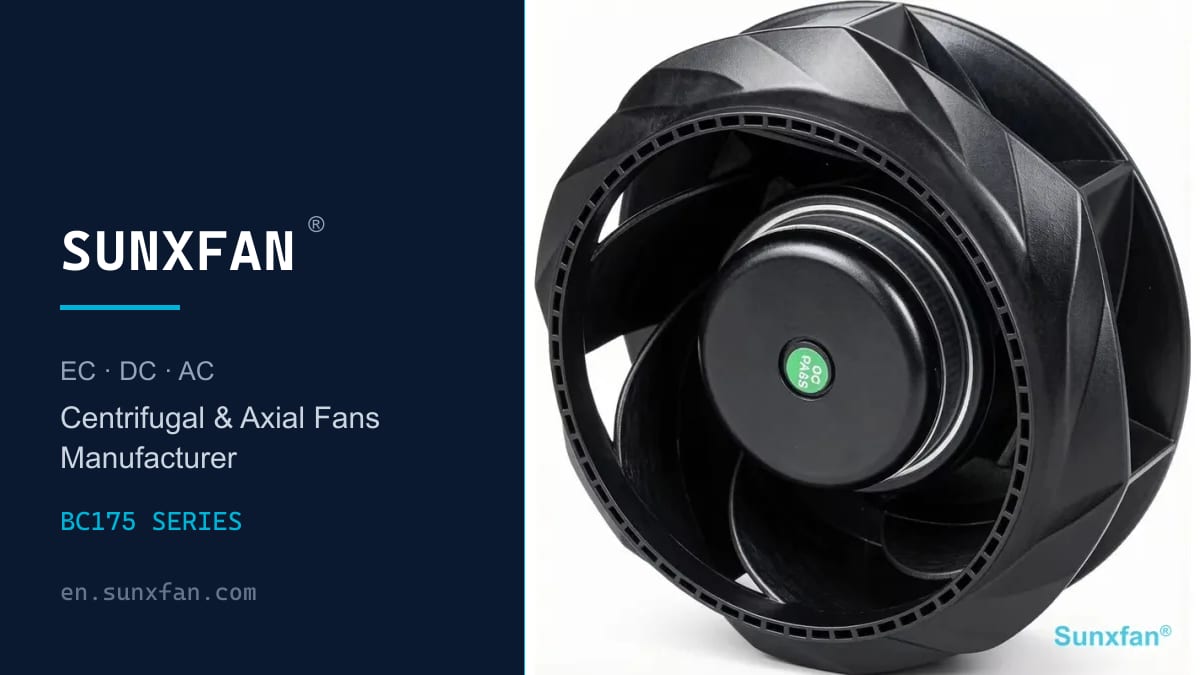
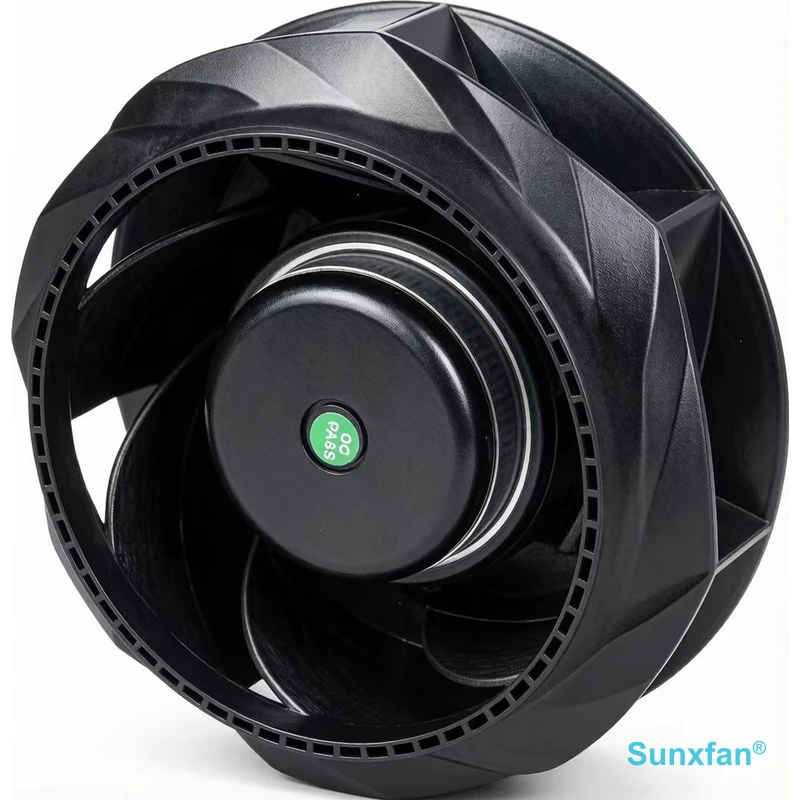
BC175 Series — Backward-Curved Centrifugal Fans

Applications
Backward-curved EC/DC centrifugal fans, 540–780 m³/h at up to 770 Pa, with a non-overloading power curve for continuous duty in AHUs, FFU/cleanroom modules, heat pumps and power-electronics cooling. 48 V DC versions run straight off telecom DC plants; IP54, -25 °C to +60 °C.
Selection notes
The BC175 range covers 5 models between 540–780 m³/h, with static pressure up to 770 Pa. Motor options are DC / EC; speed is set through 0-10V/PWM, 3-speed.
For system design this means one construction principle across the whole envelope, so installations with a similar air demand can be resolved without switching fan family. For the destination market the grid is typically 110–240 V, 50/60 Hz, with CE, UL/ETL or CCC depending on destination as the compliance framework.
| Model | Voltage | Power | Airflow | Noise | Speed Control | View Details |
|---|---|---|---|---|---|---|
| BC175B-D061B8-01 | 48 V DC | 40 W | 540 m³/h | 64±2 dB(A) | 0-10V/PWM |
| Model | Voltage | Power | Airflow | Noise | Speed Control | View Details |
|---|---|---|---|---|---|---|
| BC175B-E072A1-01 | 115 V AC | 50 W | 540 m³/h | 71 dB(A) | 0-10V/PWM, 3-speed | |
| BC175B-E072A3-01 | 230 V AC | 90 W | 680m³/h | 71 dB(A) | 0-10V/PWM, 3-speed | |
| BC175B-E072D1-01 | 115 V AC | 90 W | 680 m³/h | 71 dB(A) | 0-10V/PWM, 3-speed | |
| BC175B-E072D3-02 | 230 V AC | 120 W | 780m³/h | 75 dB(A) | 0-10V/PWM, 3-speed |
Compare Models
Select up to 4 models to compare detailed specifications. Each parameter row is color-coded.
FAQ
BC175B-D061B8-01
What does non-overloading mean on a backward-curved wheel — and why should I care?
A backward-curved wheel peaks in power and then levels off, so collapsing system resistance cannot overload the motor.
On a forward-curved fan, power keeps climbing as airflow increases, so a burst duct or a missing filter can push the motor past its rating. A backward-curved wheel like the BC175’s reaches a power peak and then levels off: even if system resistance collapses, the airflow itself cannot overload the motor. That removes a failure mode you would otherwise cover with oversized protection.
As filters load up, how do I hold airflow constant over the service interval?
Either close the loop with a filter pressure sensor on EC models, or select against the loaded filter resistance so the 770 Pa ceiling covers the whole service interval.
Two practical routes: on EC models, close the loop — a differential-pressure sensor across the filter trims the 0-10V command upward as resistance grows. Or size statically: select against the filter’s final (loaded) resistance, typically about twice the clean value, so the BC175’s 770 Pa ceiling covers the whole service life. Either way the fan stays near its efficiency island instead of slowly starving the process.
When does a 48 V DC fan beat a 230 V AC one?
When the site already runs a 48 V DC bus — telecom shelters, 48 V racks, off-grid cabins — no inverter is needed and the battery carries ventilation through a mains failure.
Whenever the site already speaks DC. Telecom shelters run −48 V plants; this fan (540 m³/h, 360 Pa) hangs straight on that bus with no inverter, and ventilation survives a mains failure because the battery string carries it. The same logic applies to solar off-grid cabins and 48 V racks: fewer conversion stages, less to fail.