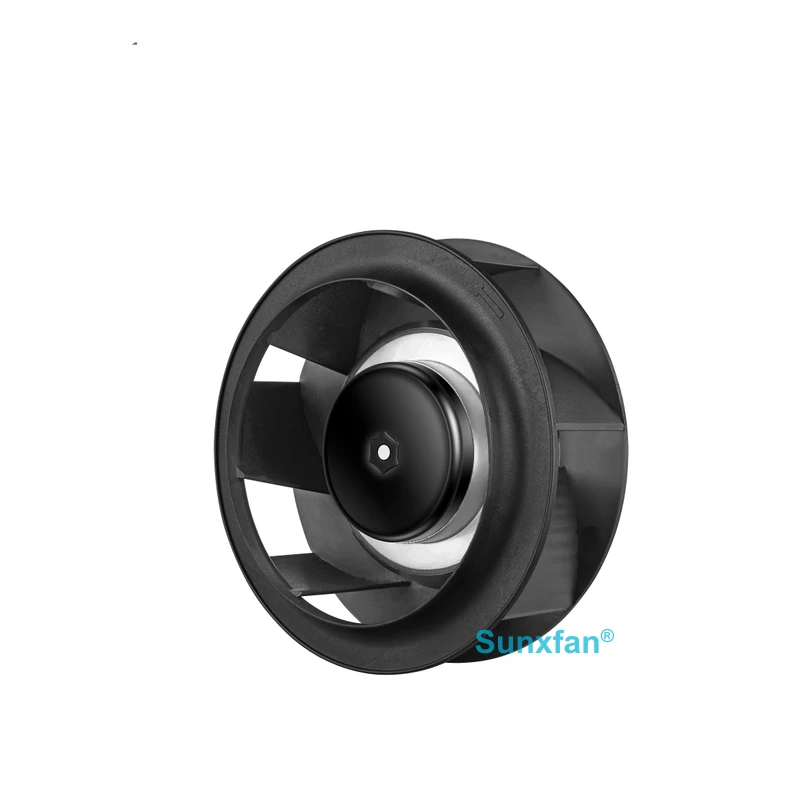
Centrifugal Fan
BC225 Series

Applications
Nine models on one 225 mm platform — AC, DC (24/48/310 V) and EC — sharing 1,020–1,420 m³/h at up to 690 Pa. Built as a drop-in platform for AHU, dehumidifier and heat-pump OEMs: one mechanical cut-out, any electrical scheme. IP54, ball bearings, continuous duty.
| Model | Voltage | Power | Airflow | Noise | Speed Control | View Details |
|---|---|---|---|---|---|---|
| BC225A-A092C2-01 | 230 V AC 50/60Hz | 120/95/87 W | 1100/890/750 m³/h | 69 dB(A) | 3-speed | View Details |
| Model | Voltage | Power | Airflow | Noise | Speed Control | View Details |
|---|---|---|---|---|---|---|
| BC225A-D072A6-01 | 24 V DC | 100 W | 1150 m³/h | 72±2 dB(A) | 0-10V/PWM | View Details |
| BC225A-D092A0-01 | 310 V DC | 120 W | 1250 m³/h | 72±2 dB(A) | 0-5V | View Details |
| BC225B-D092A8-01 | 48 V DC | 99 W | 1150 m³/h | 69±2 dB(A) | 0-10V/PWM | View Details |
| Model | Voltage | Power | Airflow | Noise | Speed Control | View Details |
|---|---|---|---|---|---|---|
| BC225A-E072B3-01 | 230 V AC | 90 W | 1200 m³/h | 68 dB(A) | 0-10V/PWM, 3-speed | View Details |
| BC225A-E092D1-02 | 115 V AC | 165 W | 1420 m³/h | 72 dB(A) | 0-10V/PWM, Modbus RTU(RS485) | View Details |
| BC225A-E092D3-02 | 230 V AC | 165 W | 1420 m³/h | 72 dB(A) | 0-10V/PWM, Modbus RTU(RS485) | View Details |
| BC225B-E072A3-03 | 230 V AC | 70 W | 1020 m³/h | 64 dB(A) | 0-10V/PWM, 3-speed | View Details |
| BC225B-E072E1-01 | 115 V AC | 100 W | 1020 m³/h | 64 dB(A) | 0-10V/PWM, 3-speed | View Details |
Compare Models
Select up to 4 models to compare detailed specifications. Each parameter row is color-coded.
FAQ
BC225B-D092A8-01
Why DC225 backward-curved centrifugal fan is a Standard in Telecom & IT for 48V DC power systems?
telecom and IT infrastructure is one of the primary applications for a DC225 backward-curved centrifugal fan—especially models designed for 48V DC power systems.
A 225mm impeller size combined with a DC/EC outer-rotor motor delivers high airflow (typically 1,000–1,500 m³/h) and strong static pressure in a compact footprint, making it ideal for densely packed electronics.
Why DC225 is a Standard in Telecom & IT
Native 48V DC Bus Compatibility: Telecom base stations and battery backup systems operate natively on 48V DC power. A 48V DC225 fan runs directly off the battery/rectifier bus without needing AC inverters or extra step-down converters.
High Static Pressure Performance: Telecom cabinets and server racks are tightly packed with PCBs, heat sinks, and dust filters. The backward-curved design pushes air through high airflow resistance without stalling.
Outer-Rotor Space Saving: The motor sits inside the impeller hub, minimizing axial depth so more space is available for electronic components.
Precision Speed Control (PWM / 0-10V / Modbus): Allows the cabinet controller to dynamically scale fan speed based on ambient temperature, cutting power consumption during off-peak hours or cooler nights.
Key Telecom & IT Equipment Using DC225 Fans
Outdoor Telecom Cabinets / BTS (Base Transceiver Stations): Primary heat extraction for 4G/5G radio equipment, rectifiers, and outdoor battery enclosures.
Energy Storage Systems (ESS) & Telecom UPS: Cools high-capacity lithium battery racks and power conversion systems.
In-Row Air Conditioners & CRAC Units: Deployed in small data centers and edge computing nodes to pull hot exhaust air directly from server racks.
High-Power Rectifier & Inverter Cabinets: Dissipates heat generated by AC-to-DC power conversion units inside telecom switching centers.
How do I navigate the nine models of the BC225 series?
Filter by power first, then by duty point. Motor options split the family — 48 V DC for telecom racks and battery rooms (this model: 1,150 m³/h, 560 Pa, 99 W), EC versions for mains sites — and within each group the models step through airflow windows at different pressure ceilings. Land your system curve on the comparison table, shortlist two candidates, then confirm the operating point on the performance data. Send us airflow plus static pressure and we will run the same check from our side.
How do the EC versions behave across the whole speed range?
Unlike a fixed-speed AC motor that only meets its nameplate at full speed, the EC versions hold efficiency from roughly 30% to 100% of speed. Pressure falls with the square of speed and airflow linearly, so at half speed you draw about an eighth of the power while the fan still tracks the system curve. That makes the EC variants the default for duty that varies — night setback, seasonal load, demand-controlled ventilation — while fixed-duty installations can stay on the simplest model that meets the point.