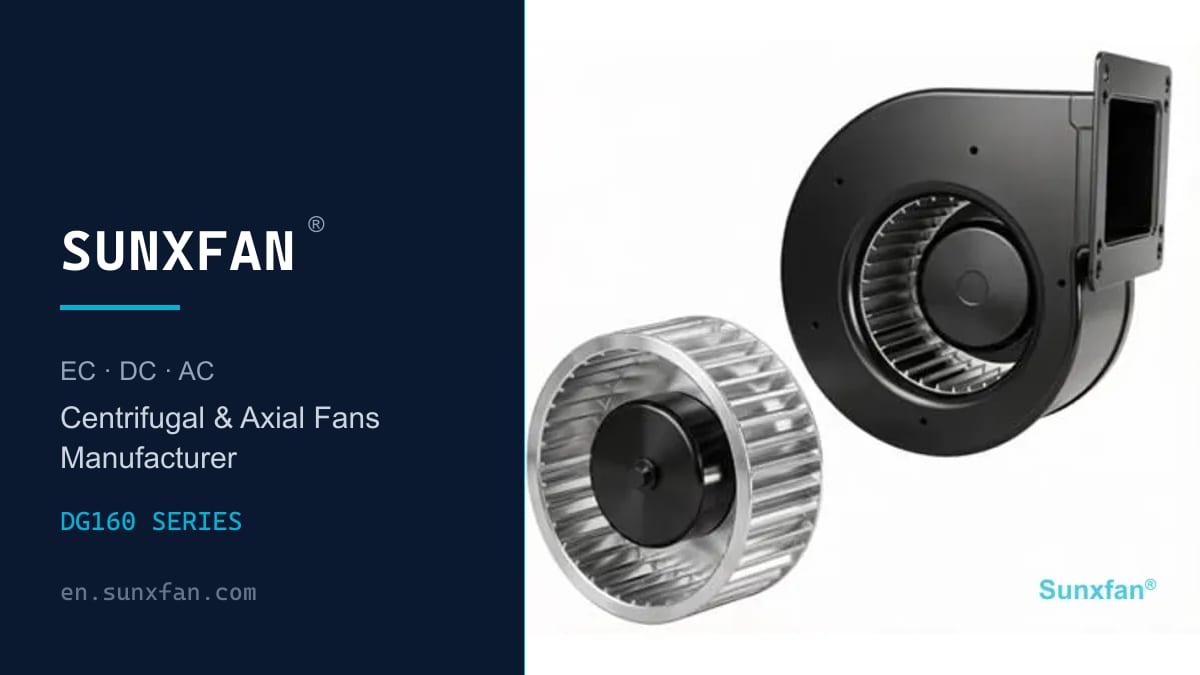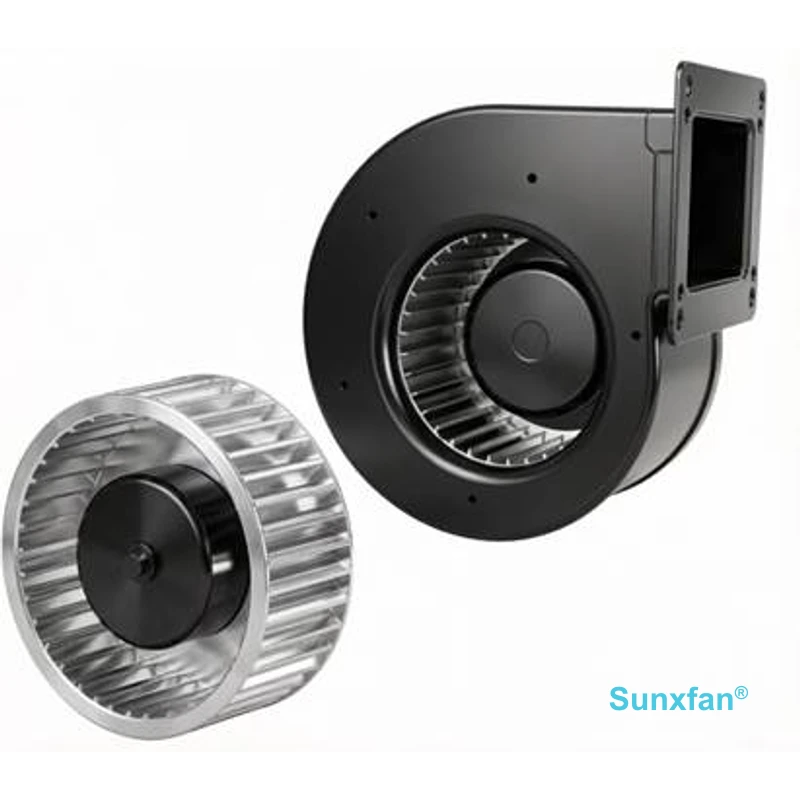
Centrifugal Fan
DG160 Series — Single-Inlet Centrifugal Fans

Applications
530–680 m³/h at 590–680 Pa from a 160 mm single-inlet wheel — pressure above its size class for compact AHU stages, filtration cassettes and appliance air paths. EC with 0-10V/PWM and 3-speed, PP or galvanized impeller, IP44.
Selection notes
The DG160 range covers 4 models between 530–680 m³/h, with static pressure up to 680 Pa. Motor options are EC; speed is set through 0-10V/PWM, 3-speed.
For system design this means one construction principle across the whole envelope, so installations with a similar air demand can be resolved without switching fan family. For the destination market the grid is typically 110–240 V, 50/60 Hz, with CE, UL/ETL or CCC depending on destination as the compliance framework.
| Model | Voltage | Power | Airflow | Noise | Speed Control | View Details |
|---|---|---|---|---|---|---|
| DG160A-E072B1-01 | 115 V AC | 80 W | 530 m³/h | 59 dB(A) | 0-10V/PWM, 3-speed | |
| DG160A-E072B3-01 | 230 V AC | 80 W | 530 m³/h | 59 dB(A) | 0-10V/PWM, 3-speed | |
| DG160B-E092D1-02 | 115 V AC | 150 W | 680 m³/h | 68 dB(A) | 0-10V/PWM, 3-speed | |
| DG160B-E092D3-02 | 230 V AC | 150 W | 680 m³/h | 68 dB(A) | 0-10V/PWM, 3-speed |
Compare Models
Select up to 4 models to compare detailed specifications. Each parameter row is color-coded.
FAQ
DG160A-E072B1-01
Why specify an EC motor in a blower this size?
An EC motor keeps efficiency at partial load, accepts 0-10V/PWM or 3-speed control, and removes the capacitor and slip losses of an AC motor at this size.
Because these fans spend their life at partial load. An EC motor holds its efficiency across the speed range, while a capacitor or shaded-pole AC motor falls off badly below rated speed — so the 80 W nameplate is what you actually draw at duty, not a laboratory best case. You also get soft start, gentler on the NSK bearings, cooler losses going into the airstream, and native 0-10V/PWM. In a filtration cassette or appliance air path that runs 8,760 hours a year, the energy saving repays the motor premium quickly.
3-speed taps or 0-10V — which control do I need?
Use taps for two or three fixed duties; use 0-10V/PWM when speed must follow a sensor — this blower accepts both.
Taps suit duty with two or three known states — boost, normal, night — selected by a plain switch, with nothing to program and nothing to fail. 0-10V/PWM earns its cost when the operating point must follow a sensor: CO₂, humidity, temperature or filter pressure drop trims the speed continuously, and any PLC or building controller drives it directly. This blower accepts both, so the design can start simple and gain intelligence later without changing the fan.
Which systems genuinely need 590–680 Pa from a 160 mm wheel?
Deep filter stages, ERV cores, long small-diameter ducts and coil-plus-bend casings — systems where one element concentrates resistance at 530–680 m³/h.
Systems where one element concentrates the resistance: a deep filter stage, an ERV core, a long or branching small-diameter duct, a condensing-unit casing with coils and bends in series. That is the DG160’s home ground — 530–680 m³/h pushed through real resistance. If your circuit is one clean duct and a grille, this pressure class is over-spec: the DG180 moves 780–960 m³/h at 330–360 Pa and will be quieter per unit of air moved.