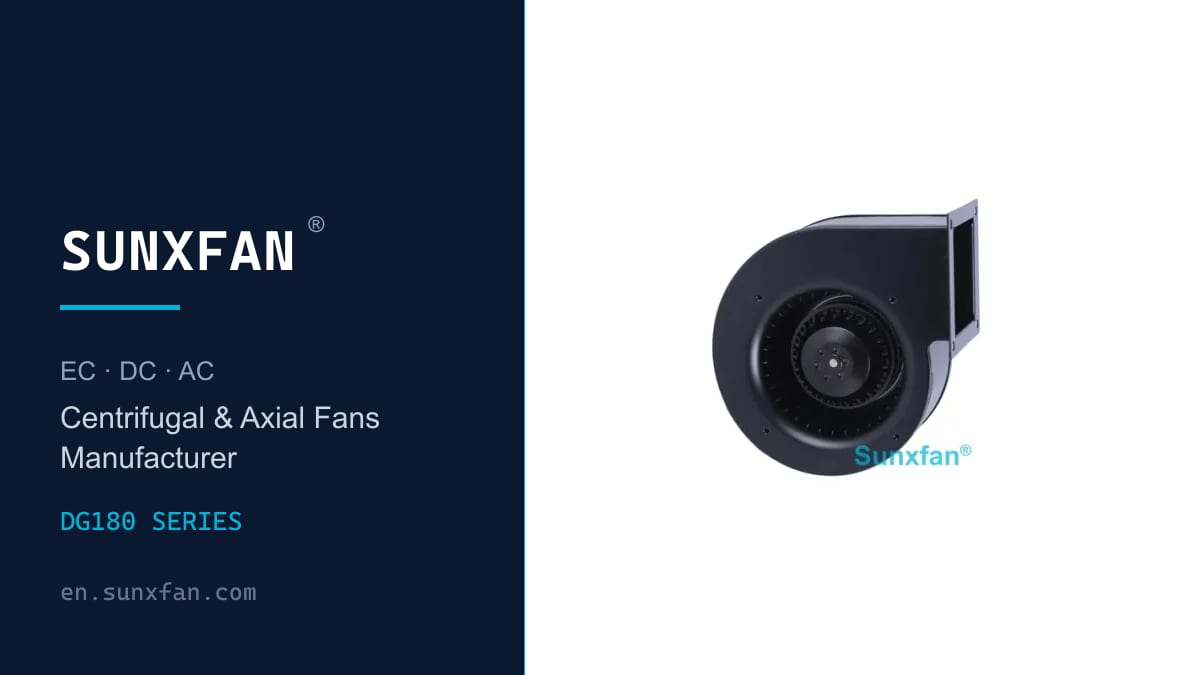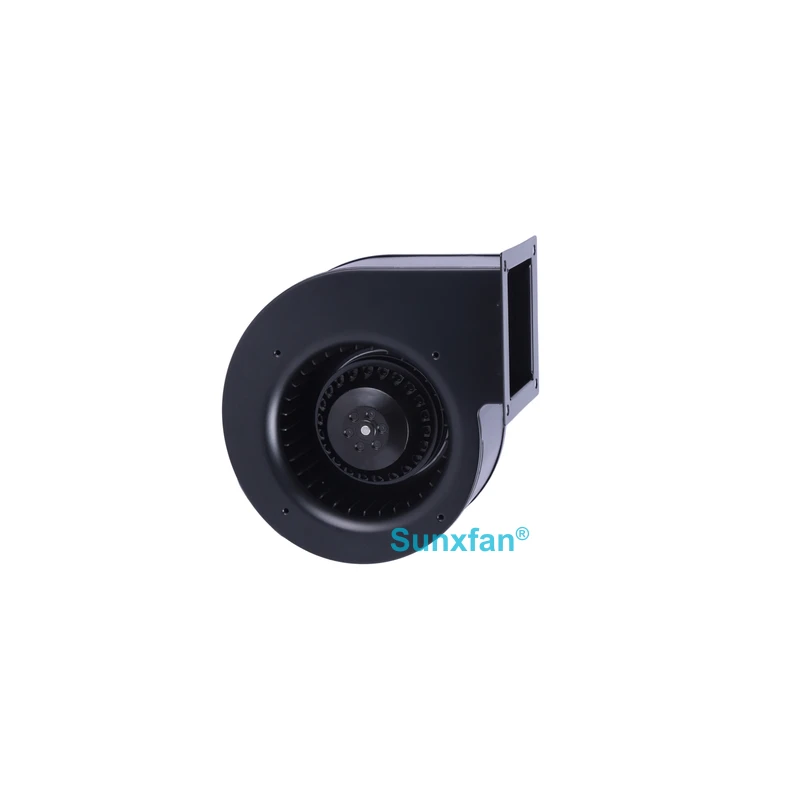
Centrifugal Fan
DG180 Series — Single-Inlet Centrifugal Fans

Applications
An airflow-first single-inlet blower: 780–960 m³/h at 330–360 Pa, tuned for short-duct and grille duty in condensing units, appliance exhaust and cabinet exchange. EC with 0-10V/PWM and 4-speed, PP impeller, IP44.
Selection notes
The DG180 range covers 4 models between 780–960 m³/h, with static pressure up to 360 Pa. Motor options are EC; speed is set through 0-10V/PWM, 4-speed, 3-speed.
For system design this means one construction principle across the whole envelope, so installations with a similar air demand can be resolved without switching fan family. For the destination market the grid is typically 110–240 V, 50/60 Hz, with CE, UL/ETL or CCC depending on destination as the compliance framework.
| Model | Voltage | Power | Airflow | Noise | Speed Control | View Details |
|---|---|---|---|---|---|---|
| DG180A-E092E1-01 | 115 V AC | 175 W | 960 m³/h | 66 dB(A) | 0-10V/PWM, 4-speed | |
| DG180A-E092E3-01 | 230 V AC | 175 W | 960 m³/h | 66 dB(A) | 0-10V/PWM, 4-speed | |
| DG180B-E092D1-01 | 115 V AC | 120 W | 780 m³/h | 67 dB(A) | 0-10V/PWM, 3-speed | |
| DG180B-E092D3-01 | 230 V AC | 120 W | 780 m³/h | 67 dB(A) | 0-10V/PWM, 3-speed |
Compare Models
Select up to 4 models to compare detailed specifications. Each parameter row is color-coded.
FAQ
DG180A-E092E1-01
When is a 330–360 Pa, high-airflow blower the right choice?
When the resistance is short and honest: condensing-unit discharge, appliance exhaust up a short stack, cabinet air exchange through a grille and maybe one bend.
When the resistance is short and honest: condensing-unit discharge, appliance exhaust up a short stack, cabinet air exchange through a grille and maybe one bend. 780–960 m³/h at 330–360 Pa moves serious volume through such paths without paying the noise and power premium of a high-pressure wheel fighting an open system. The mistake to avoid is the reverse: a 700 Pa-class blower on a 150 Pa system rides far off its design point, wastes energy and sounds harsh.
4-speed taps or 0-10V/PWM — how do I choose?
The 4-speed taps serve uncontrolled installs: a technician sets one point with a jumper or switch — kitchen boost, condenser duty, appliance exhaust — and the fixed steps guarantee repeatable airflow and noise. 0-10V/PWM is for when a controller or BMS will trim speed against a sensor. On fixed duty, land the tap on your actual system curve rather than defaulting to the fastest: each step down buys several dB(A) and a cubic saving in power.
What does the PP impeller contribute here?
Glass-fibre-filled polypropylene keeps wheel mass low: gentle bearing loads over years of continuous running and little start inertia for the EC motor.
Glass-fibre-filled polypropylene keeps wheel mass low: gentle bearing loads over years of continuous running and little start inertia for the EC motor. It is intrinsically corrosion-proof — salt air, humidity and cleaning-agent traces that pit coated steel leave it untouched, which is why appliance and marine-air-conditioning duty favours it. The honest trade is temperature: respect the −25 ~ +60 °C envelope; for airstreams that live near that ceiling, specify a steel-wheel blower instead.