
In the fan world we negotiate with air every day. Every impeller arc and every volute curve rests on the same set of equations: Navier–Stokes. They describe how a viscous fluid moves — the mathematical floor under weather forecasting, aircraft design and the aerodynamics of every centrifugal and axial fan we build.
For more than two decades, one question has been hanging over that floor: in three dimensions, with smooth initial data, does the solution stay smooth forever, or can it “blow up” in finite time, sending velocity or vorticity to infinity?
In 2026 that question genuinely turned. Not because it was solved, but because the mathematical community began to take seriously a possibility it had long resisted: that blow-up may be the intrinsic behaviour of a fluid under extreme conditions, and that smoothness is the case requiring extra explanation.
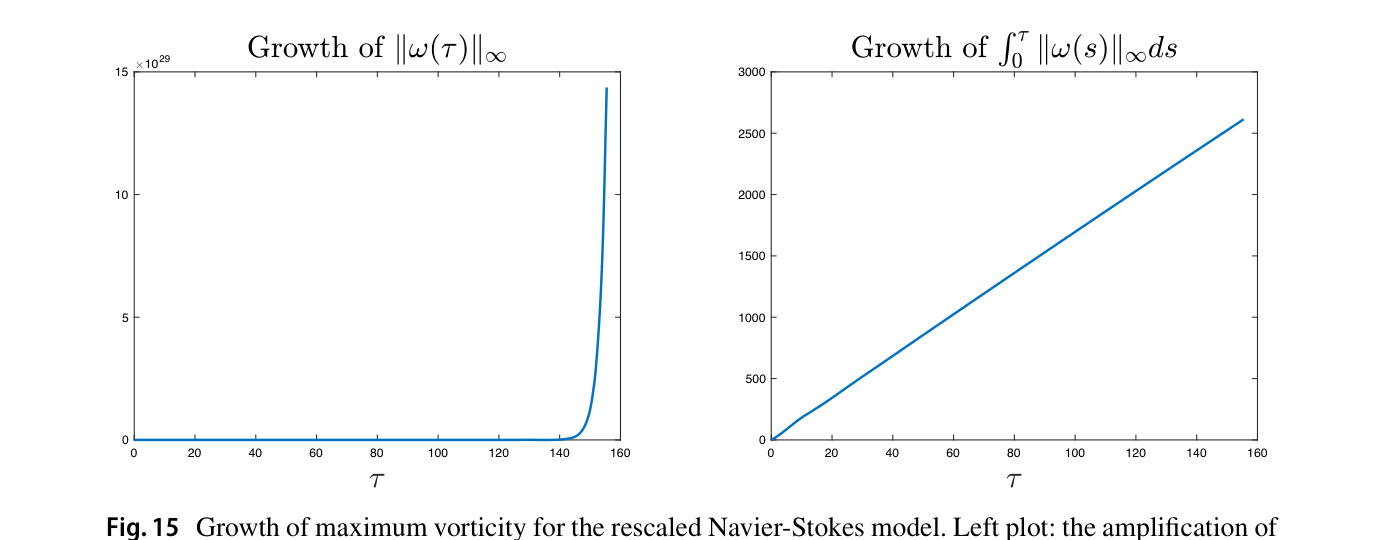
Figure 1 — Vorticity evolution for the 3D Navier–Stokes equations in a generalised axisymmetric setting. Peak vorticity grows sharply in finite time and the integrated vorticity violates the Beale–Kato–Majda criterion, which is exactly the numerical signature a finite-time singularity would leave. Original figure: reference 1 (Hou, J. FoCM 2026, Fig. 15/16).
1. The 2026 turn: three lines of evidence pointing the same way
1.1 OpenAI’s forced blow-up: a shock to the field, not a verdict
On 8 September 2026 OpenAI announced that a multi-agent system had, in roughly 88 hours, constructed a finite-time blow-up for the 3D incompressible Navier–Stokes equations driven by a smooth, compactly supported forcing term, verified in Lean 4. Read the headline alone and it looks like a direct answer to the Millennium Prize problem.
Scrutiny came fast. An independent Lean audit found that the compiled formalisation did not faithfully translate the natural-language manuscript: Lemma 8.6 claims control of the inverse operator with m+4 derivatives, while the Lean code requires m+5. The deeper objection is about the problem statement itself. The Millennium version is unforced and finite-energy; the OpenAI construction leans on a designed smooth forcing that keeps pumping enstrophy into high wavenumbers. Whether a forced blow-up answers an unforced question is nowhere near settled. The Clay Mathematics Institute has accepted nothing, and OpenAI itself said it would not claim the prize.
1.2 Caltech’s PINN: a self-similar profile in an unforced world
The contrast to OpenAI’s forced route is a Caltech team’s physics-informed neural network construction of a self-similar blow-up profile for the 3D Euler equations — unforced, unbounded, free space. Terence Tao publicly endorsed that line of approach the night before OpenAI’s announcement. Its significance is methodological: nothing external is injected; the equations are left to evolve their own singularity, which is closer to the picture of an intrinsic hydrodynamic instability.
1.3 The consensus drifts: from “prove smoothness” to “understand blow-up”
What matters more than any single proof is that the consensus itself is moving. In 2026 Tao stated plainly that thinking in the field has shifted, and that the regularity conjecture is now widely regarded as false — that specific initial data will blow up in finite time. Through 2025–2026, independent groups reported constructions or strong evidence from chained vortex-tube stretching, topological locking, and cascade mechanisms. The collective effort is migrating from proving that solutions stay smooth to describing when, and in what manner, they fail to.
2. The geometry behind blow-up: a vorticity-stretching feedback loop
The reason Navier–Stokes can run away is a geometric mechanism that 3D flow cannot avoid: vortex stretching. Stretch a vortex tube along its axis and angular momentum conservation forces it to spin faster and thinner; spinning faster amplifies the stretch further. That is a positive feedback loop. The mathematical question is whether viscous dissipation is always strong enough to hold it down.
Caltech’s numerics show the consequence plainly: in the generalised axisymmetric equations, peak vorticity grows as O(1/(T−t)) in finite time and the integrated vorticity violates the Beale–Kato–Majda criterion, marking the formation of a finite-time singularity. Viscosity plays a counter-intuitive role here. Because viscous regularisation makes the solution smoother and more stable, it can actually reinforce the nonlinear alignment that drives vortex stretching rather than damp it.
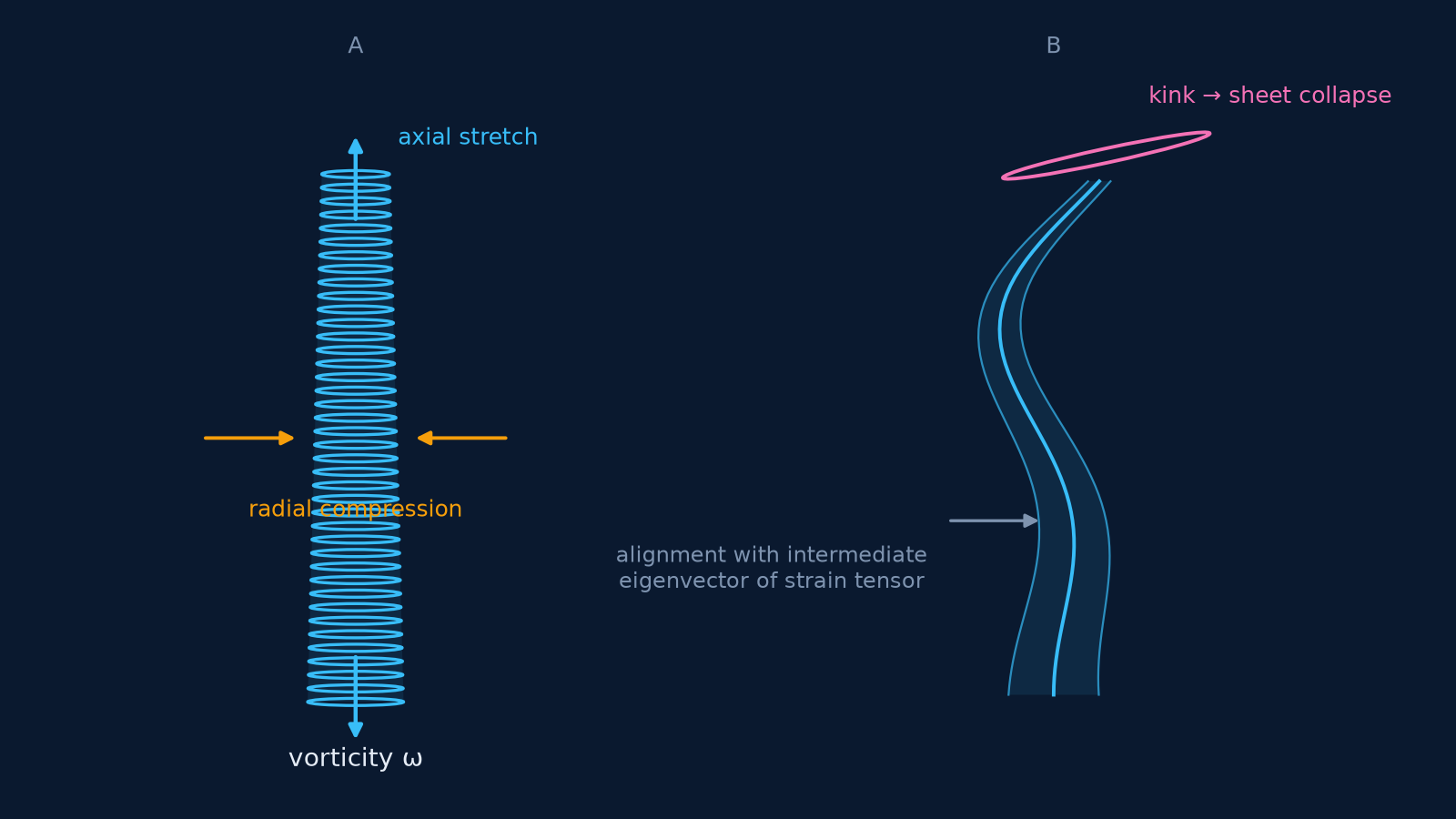
Figure 2 — Schematic of vortex-tube stretching. As a tube is stretched axially and compressed radially, vorticity tends to align with the intermediate eigenvector of the strain-rate tensor, and the tube eventually kinks and collapses into sheets. This is the geometry of the stretching term itself. Original figure: reference 2 (Ruhr-Universität Bochum, Fig. 2.3); redrawn here for clarity.
3. What this means for fan engineers: a widely misread conclusion
The common misreading goes like this: if Navier–Stokes can blow up, then CFD and fan design built on it are invalid.
The opposite is true. Blow-up is a statement about a continuum model at infinite resolution under extreme conditions. Engineering CFD never solves that problem. It solves a tamed version: bounded geometry, a discrete mesh, a RANS or LES turbulence closure, and a target defined in terms of mean flow. What engineers actually fight every day is not vorticity running to infinity but steep gradients, under-resolved eddies, separation, and closures that quietly stop working in certain operating regimes.
A 2025 large-eddy simulation of electronics-cooling axial fans makes that “engineering non-smoothness” visible. At normal back pressures (0 and 6 mmH₂O) the suction-side flow stays attached, paired inlet vortex tubes appear with good coherence, and tip-leakage vortices are clearly defined. At 12 mmH₂O a separation zone appears at the leading edge and the separated vortex spirals out toward the tip. At the 18 mmH₂O stall condition the inlet vortex tubes disappear entirely, replaced by chaotic, diffused large-scale turbulence, while the suction-side separation zone spreads to roughly 80% of blade height and 20% of chord. No singularity appears anywhere in this picture — but a fact does: turbulence closures hold up in attached flow and lose credibility in wide separation and stall.
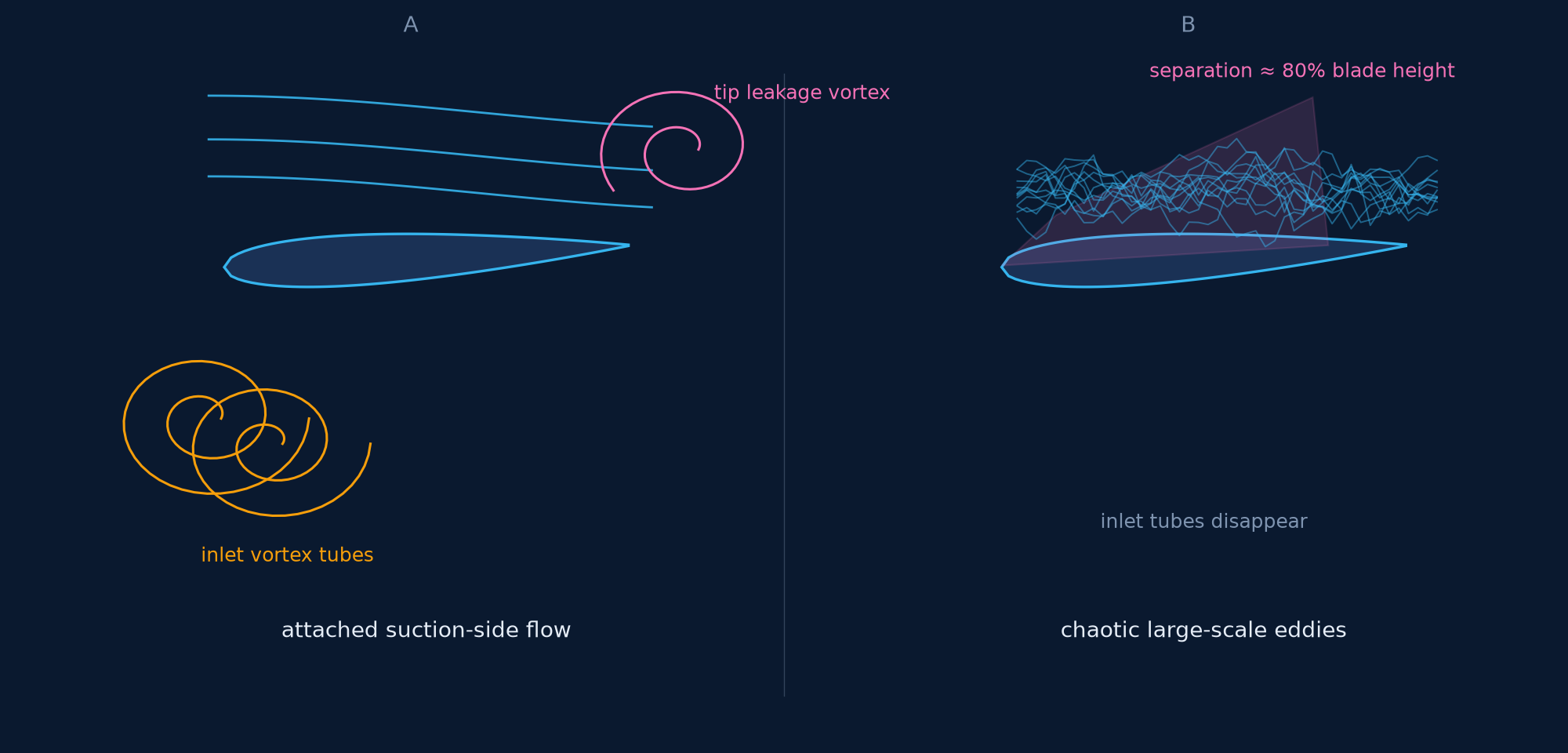
Figure 3 — Axial fan flow structure, normal versus stall. Attached suction-side flow with coherent inlet vortex tubes and defined tip-leakage vortices on the left; on the right, the inlet tubes are gone, large-scale turbulence dominates and the separation zone spreads across the blade. This is the non-smooth reality engineering CFD handles every day, and it marks the validity boundary of the closure. Original figures: reference 3 (Applied Acoustics 2025, Fig. 15–18); schematic redrawn here.
4. The SUNXFAN view: an accurate model is an efficiency and noise variable
One easily underestimated fact about the fan industry: every point of aerodynamic efficiency and every decibel of noise reduction ultimately comes from a more accurate description of the flow structure.
Whether an EC centrifugal fan holds its high-efficiency island at part load depends on whether secondary flow and separation vortices inside the impeller stay within the intended envelope. A CFD study of a forward-curved multi-blade centrifugal fan found a large recirculation zone in the bend at the impeller inlet, pronounced separation triggered at the blade leading edge, and jet–wake interaction between the volute tongue and the impeller wake — a major source of flow unsteadiness and discrete noise. A separate internal-flow study of multi-blade centrifugal fans likewise observed recirculation and large eddies inside the blade passages even at the best-efficiency point. None of this is a mathematical singularity, but all of it is the same Navier–Stokes equation expressed at engineering scale.
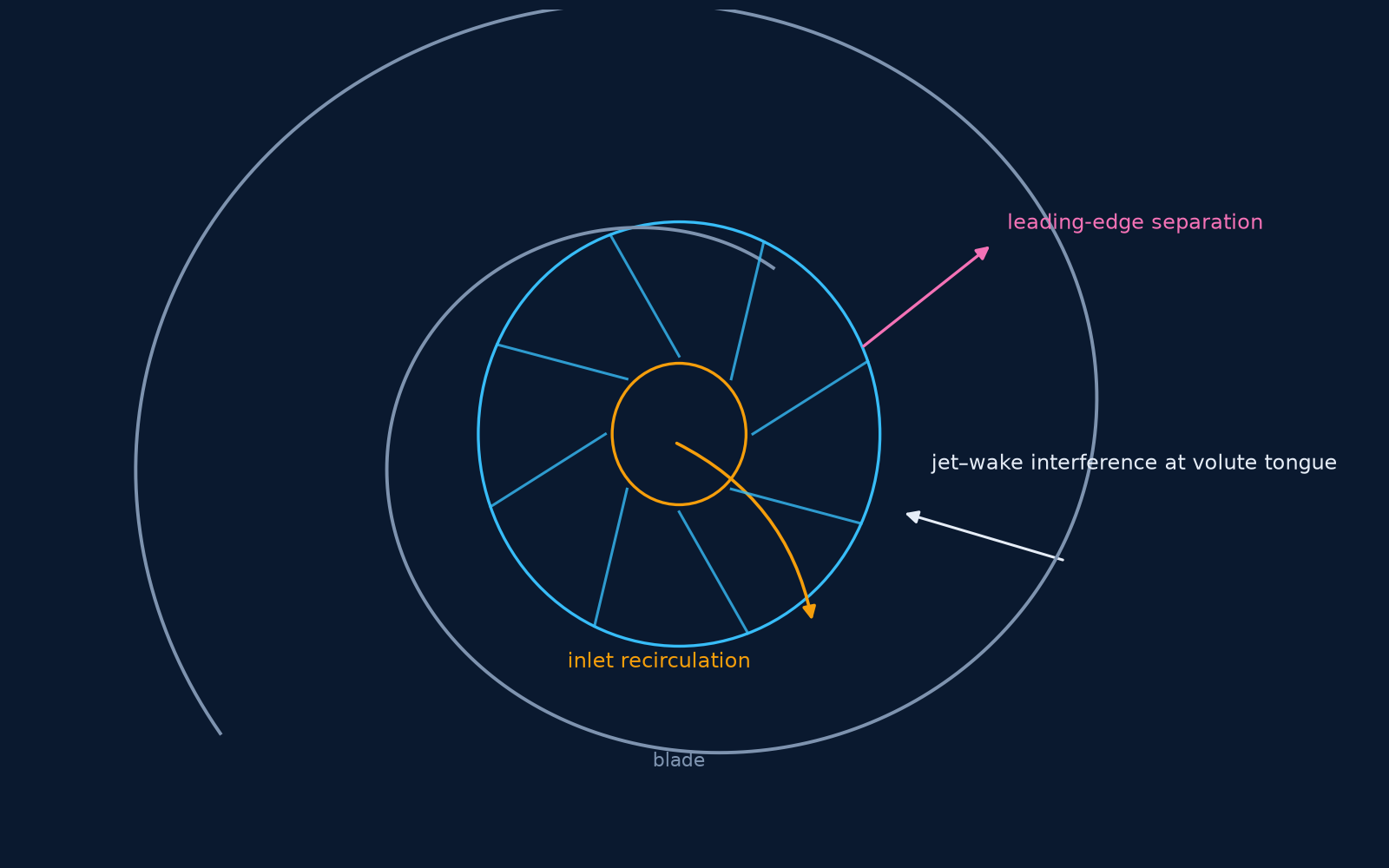
Figure 4 — Streamlines and velocity field inside a centrifugal impeller. Inlet recirculation, leading-edge separation and jet–wake interference near the volute tongue are the core sources of efficiency loss and discrete noise. No singularity is involved, yet this is the Navier–Stokes equation at engineering scale. Original figures: reference 4 (TU Darmstadt, Fig. 9/12); schematic redrawn here.
The practical value of the 2026 mathematical frontier is not the blow-up proof itself. It is the simulation culture it encourages: validity-aware CFD, where you know which operating points the model can carry and which need local refinement, a different closure, or a return to physical testing. For the HVAC, data-centre and energy-storage cooling, clean-air and 800V HVDC duties SUNXFAN serves, that means judging more clearly which aerodynamic decisions can be handed to CFD and which must be anchored in measured data.
5. Closing: mathematics admits the fluid can run away, engineering learns to live with it
The existence and smoothness problem for Navier–Stokes is far from solved in 2026. OpenAI’s result is contested, Caltech’s construction still needs independent verification, and the Clay Institute’s million dollars remains unclaimed. What did change is the default assumption: global smoothness is no longer taken for granted, and the structure, conditions and consequences of blow-up are now a legitimate research target.
For the engineers standing behind a fan, that is a familiar posture. We never owned a permanently smooth flow world. We own separation, mixing, unsteadiness and boundary layers struggling against an adverse pressure gradient. The frontier moved because mathematics finally admitted, in its most rigorous language, what engineers face daily: air does not always behave. Real engineering is still delivering an efficient, quiet and reliable fan where it does not.
References
- Hou, T. Y. J. FoCM (2026): rapid growth of maximum vorticity and the BKM blow-up criterion in the generalised axisymmetric Navier–Stokes equations.
- Ruhr-Universität Bochum, doctoral dissertation, Figure 2.3: vortex-tube stretching and sheet-like collapse.
- Applied Acoustics (2025): LES of electronics-cooling axial fans at normal and stall conditions, Fig. 15–18.
- TU Darmstadt: CFD analysis of a centrifugal fan, velocities and streamlines, Fig. 9–12.
- Zenodo, “A Structural Dismantling of OpenAI’s ‘Finite-Time blowup for Navier–Stokes’,” September 2026.
- Zenodo, “Navier–Stokes Lost in Translation,” October 2026: on the Lean formalisation mismatch and forced versus unforced problem statements.
- Terence Tao, public comments on the shift in the Navier–Stokes regularity consensus, 2026.
About SUNXFAN®: SUNXFAN manufactures industrial EC, DC and AC centrifugal and axial fans for HVAC, data-centre and energy-storage thermal management, and clean-air applications, including fan units built for 800V HVDC architectures. We believe sustained attention to the most basic questions in fluid mechanics is what keeps fan systems efficient and reliable over the long run.