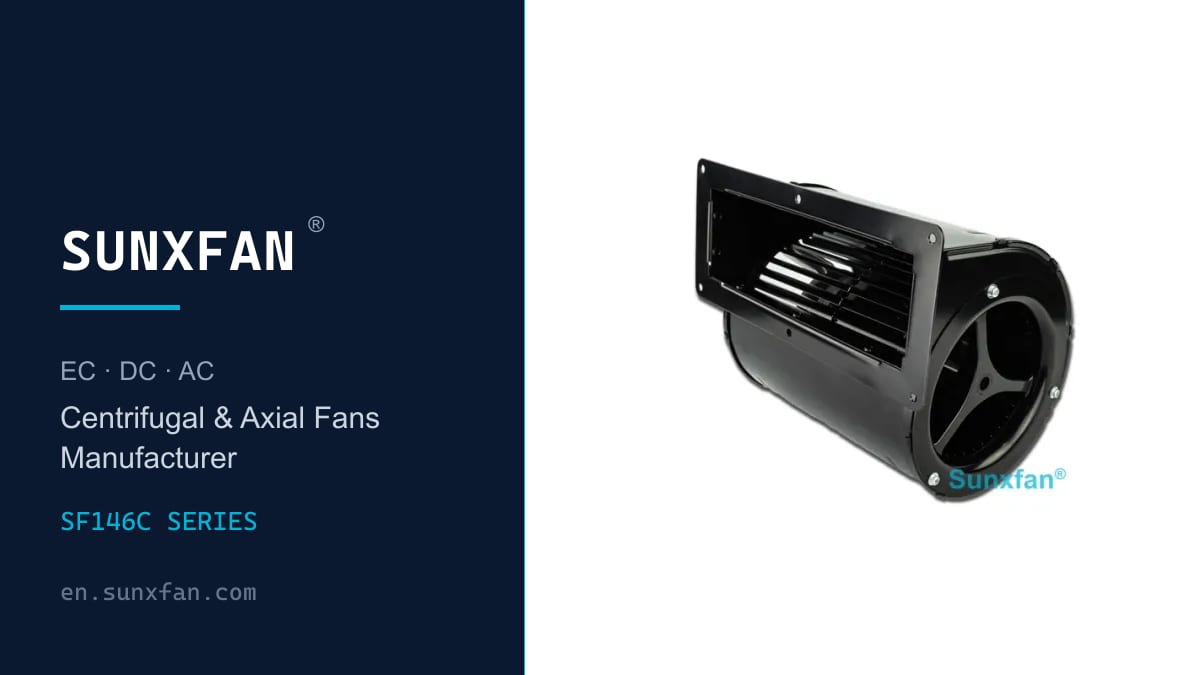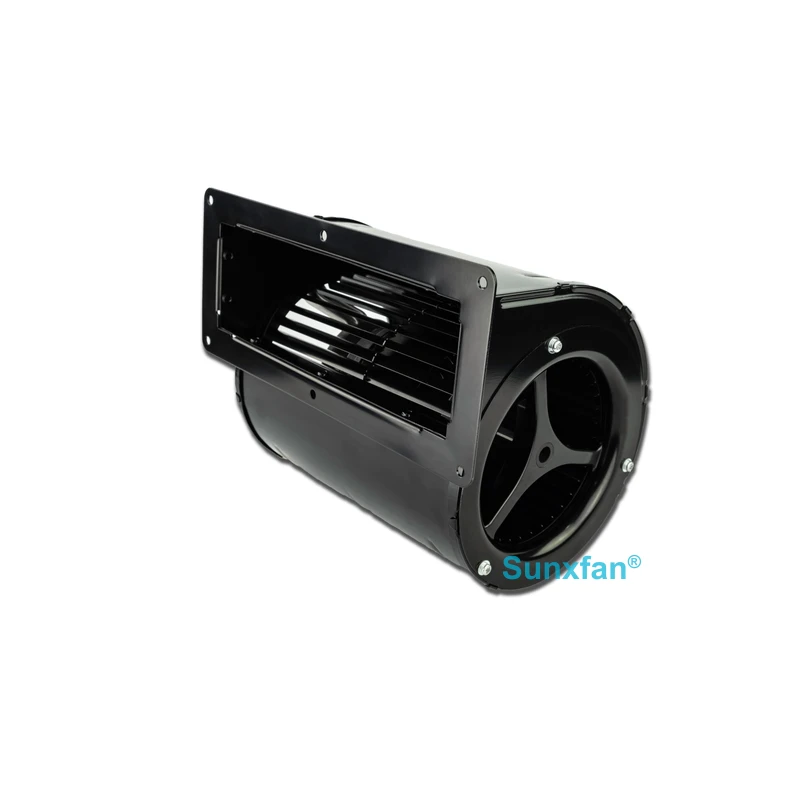
Centrifugal Fan
SF146C Series — Double-Inlet Centrifugal Fans

Applications
The high-pressure 146 mm dual-inlet build: 1,150–1,250 m³/h at 675–705 Pa for ERV/HRV cores, HEPA stages and dryer air paths. 310 V DC (inverter-appliance bus) or 115/230 V AC; 0-6.5 V or 4-speed control, IP44.
| Model | Voltage | Power | Airflow | Noise | Speed Control | View Details |
|---|---|---|---|---|---|---|
| SF146C-D092B0-03 | 310 V DC | 180 W | 1200 m³/h | 64±2 dB(A) | 0-6.5V, 4-speed |
| Model | Voltage | Power | Airflow | Noise | Speed Control | View Details |
|---|---|---|---|---|---|---|
| SF146C-E092B1-02 | 115 V AC | 165 W | 1150 m³/h | 60±2 dB(A) | 0-10V/PWM, 0-5V, 0-6.5V, 4-speed | |
| SF146C-E092B3-01 | 230 V AC | 220 W | 1250 m³/h | 65±2 dB(A) | 0-10V/PWM, 0-5V, 0-6.5V, 4-speed |
Compare Models
Select up to 4 models to compare detailed specifications. Each parameter row is color-coded.
FAQ
SF146C-D092B0-03
Why do ERV/HRV units need a 700 Pa-class blower?
Because the core is the largest single resistance in the machine: a counterflow plate exchanger plus its pre-filter commonly costs 150–300 Pa clean, and a loading filter roughly doubles that before you add ducts, silencers and the outdoor mesh. At 1,200 m³/h and 705 Pa, this blower keeps the nominal fresh-air rate alive across the whole service interval — the classic failure of undersized fans in HRVs is airflow decaying between filter changes, which quietly wrecks the indoor CO₂ budget.
What does dual-inlet (DIDW) construction buy?
One wheel fed from both faces: nearly twice the volume of a single-inlet wheel at equal diameter and speed, which is how 146 mm reaches 1,200 m³/h.
One wheel fed from both faces: nearly twice the volume of a single-inlet wheel at equal diameter and speed, which is how 146 mm reaches 1,200 m³/h. The symmetric inflow also cancels most axial thrust, so the NSK bearings run lightly and the assembly keeps its balance at speed. In an ERV or appliance cabinet that means one compact blower replaces two, with a smooth, flat power draw across the range.
310 V DC or 230 V AC — how do I pick?
Follow the power stage already in the unit.
Follow the power stage already in the unit. The 310 V DC version exists because inverter appliances — heat pumps, ERVs with variable-speed compressors, energy-storage and telecom equipment — already run a rectified DC bus at roughly that level; hanging the blower directly on it deletes an entire AC-DC conversion stage. If the unit plugs into the mains and has no DC bus, the EC versions (115/230 V AC, 1,150–1,250 m³/h, 0-6.5 V or 4-speed) are the cleaner fit. Same chassis, same 705 Pa duty.