
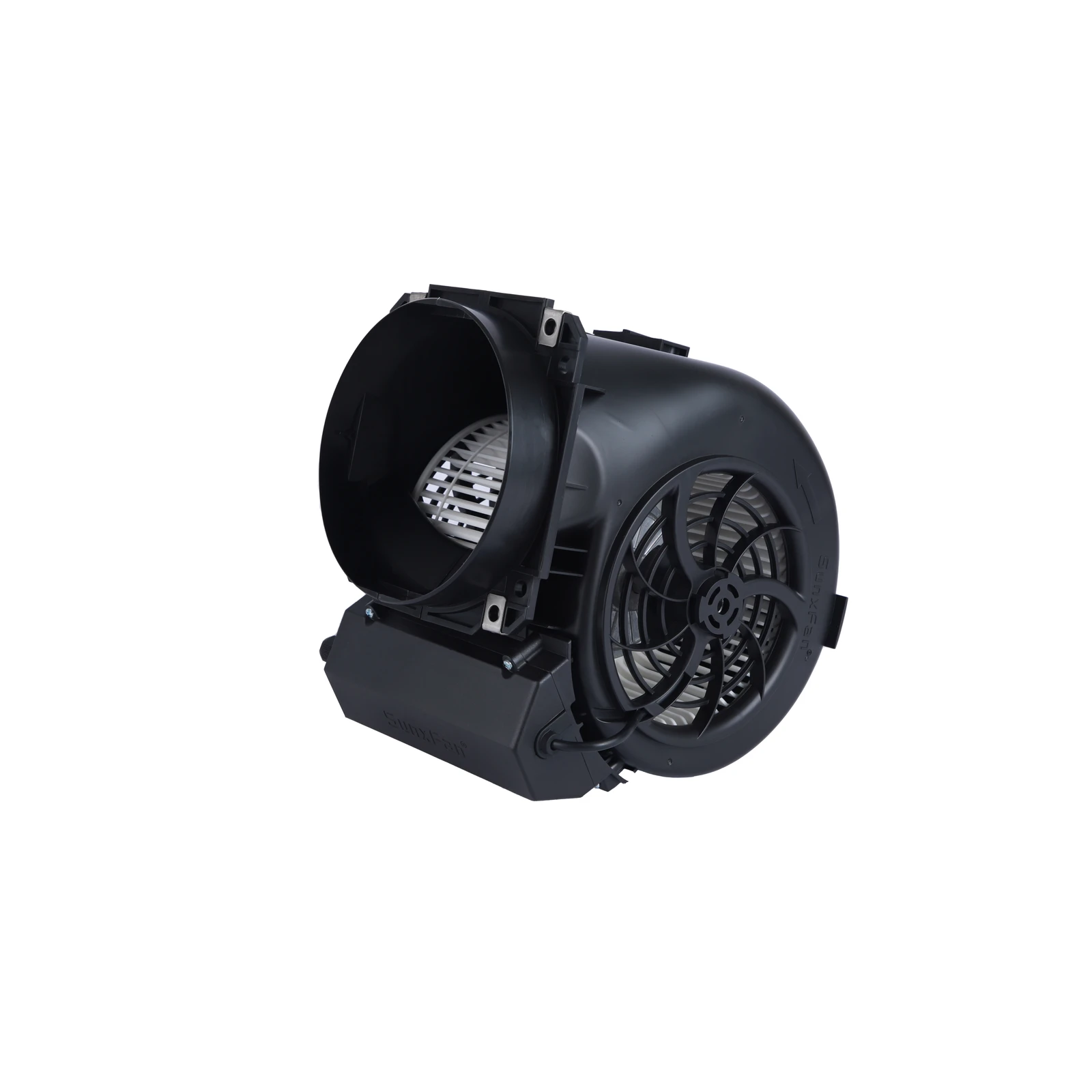
Product Overview
SF146A-E092B3-03 is an EC centrifugal fan with a 230 Vac input, delivering 1180 m³/h at up to 700 Pa, 220 W, 2200 r/min, 68±1 dB(A). Used in AHUs, fan coils, range hoods, air purifiers and ERV units. USD 50–120 FOB Nansha, MOQ 120 pcs, 25–30 days.
- Compact industrial housing (IP42)
- Long-life NSK ball bearings
Technical Specifications
| Category | Centrifugal Fan |
|---|---|
| Model | SF146A-E092B3-03 |
| Motor Type | EC |
| Airflow | 1180 m³/h |
| Max Static Pressure | 700 Pa |
| Voltage | 230 V AC |
| Power | 220 W |
| Current | 0.96 A |
| Speed | 2200 r/min |
| Noise | 68±1 dB(A) |
| Protection Class | IP42 |
| Working Temperature | -25 °C ~ +50 °C |
| Impeller Material | PA6+GF25% |
| Bearing Type | NSK ball bearing |
| Speed Control | 0-10V/PWM, 0-5V, 0-6.5V, 3-speed, 4-speed |
Data updated 2026-10
Ordering Information
| MOQ (Min. Order Qty) | 120 PCS |
|---|---|
| FOB Price | FOB Nansha Guangzhou |
| Reference price | US$50–120 |
| Lead Time | 25-30 days |
| Sample | Sample available |
| Payment Terms | TT |
| Shipping Port | Nansha Guangzhou OR Yantian Shenzhen |
Other Models in This Series
Performance Curves
Dimensions

Special Remarks
[Optional] Housing and impeller material: PP
Applications
146 mm dual-inlet blowers, 720–1,180 m³/h at 515–700 Pa, from 52 dB(A) — the range-hood and air-curtain workhorse, equally at home in slim ERV cores and purifier towers. 24/310 V DC and 115/230 V AC builds, IP42.
Product dataSheets (PDF Download)
View Product dataSheets (PDF) PDF · EC·Centrifugal fan:SF146A-E092B3-03 Product dataSheetsFrequently Asked Questions
What is an EC fan?
An EC fan is a fan that directly connects to an AC power source (such as 220V/50Hz or 115V/60Hz) and uses a built-in controller to convert AC to DC, then applies an electronic driver board to control motor winding current switching, replacing the mechanical commutation (carbon brushes) of traditional motors. Its working process is as follows: 1. Power supply: Directly connected to an AC power source (such as 220V/50Hz or 115V/60Hz), without the need for an external DC power supply or VFD. 2. Rectification: The built-in controller converts AC power to DC power. 3. Electronic commutation: With a built-in electronic driver board, the electronic circuit controls the current switching of the motor windings, replacing the mechanical commutation (carbon brushes) of traditional motors. 4. Speed control: Precisely adjusts the speed based on external control signals (0-10V, PWM, or Modbus). 5. Load efficiency: Maintains a flat, high-efficiency curve across the 10%-100% load range. 6. No carbon brush electromagnetic humming, and noise remains stable during speed adjustment; EC fans can achieve an additional 15%-35% energy savings within the typical 30%-70% operating range.
How to select and match EC fans?
EC fan selection requires a systematic evaluation of the operating point, fan type, motor performance, control method, environmental protection, and installation dimensions, rather than simply "matching airflow." The following is a seven-step engineering selection process: 1. Determine the operating point (airflow + static pressure) This is the foundation of selection. Never rely solely on the "free air flow" specification; both airflow and total system static pressure must be determined simultaneously. Airflow calculation: Sensible heat load method: Q (kW) = m × cp × ΔT, where cp = 1.006 kJ/kg·K (air) Volumetric airflow: V (m³/h) = Q / (1.2 × 1.006 × ΔT) × 3600 Typical ΔT values: 10K for office HVAC, 12K for data center CRAH, 8K for residential Static pressure calculation: At the design airflow, sum the pressure losses of all components: System component Typical static pressure range (Pa) Filter 50–250 (G4 clean 80Pa/dirty 250Pa; F7 clean 200Pa/dirty 400Pa) Heating/cooling coil 100–400 Damper 30–100 Duct friction 200–500 Diffuser/terminal 50–150 Total static pressure = sum of all items × 1.1 (safety factor). A 10–15% static pressure margin must be reserved because resistance increases as filters accumulate dust. 2. Select the fan type Choose the appropriate fan family based on the total system static pressure range: Total static pressure (Pa) Recommended fan type Typical applications < 400 EC axial fan Condensers, dry coolers, large ventilation ducts 400–1,800 EC backward-curved centrifugal plug fan AHU, CRAH, FFU, heat pumps, energy storage air conditioners 1,800–3,200 High-pressure EC plug fan Liquid cooling units, dust collectors, high-density heat exchangers For high-resistance complex ductwork, backward-curved centrifugal EC fans are most suitable; for high-airflow, low-resistance scenarios, EC axial fans can be selected; mixed-flow EC fans balance both airflow and static pressure requirements. 3. Use performance curves to determine fan size Plot the calculated operating point (airflow + static pressure) on the PQ performance curve of candidate fans, and select the smallest high-efficiency size that covers this operating point. Data center fan walls commonly use Ø355–630mm, while compact models commonly use Ø133–310mm. 4. Calculate motor power P (W) = (V × Pa) / (η × 1000), where V is in m³/s, Pa is total pressure, and η is fan efficiency; add a 10% margin to the result. The motor nameplate power should be ≥ calculated value × 1.1. 5. Determine the ingress protection rating (IP rating) Select the IP rating based on the installation environment. Humid and dusty environments require IP55 or higher; cleanrooms and medical environments require consideration of corrosion resistance and easy-to-clean design. 6. Select the control method EC fans support multiple control interfaces and must match your control system: Control method Features Applicable scenarios 0-10V analog Simple wiring, conventional wiring ≤50m Building automation (BMS), simple speed control 4-20mA Stronger interference immunity than 0-10V Industrial environments PWM Suitable for embedded controllers OEM equipment integration Modbus RTU/RS485 Supports networked control, maximum wiring length 1000m, supports remote read/write of speed, current, and fault codes Large-scale cluster management, data centers 7. Verify noise and installation dimensions Confirm whether the noise limit meets project requirements (medical and educational scenarios are noise-sensitive), and check whether the fan's installation space dimensions match. The integrated design of EC fans eliminates the need for a separate VFD cabinet, saving installation space.