Fan Units
Duct Fan Series — Inline Duct Fans

Applications
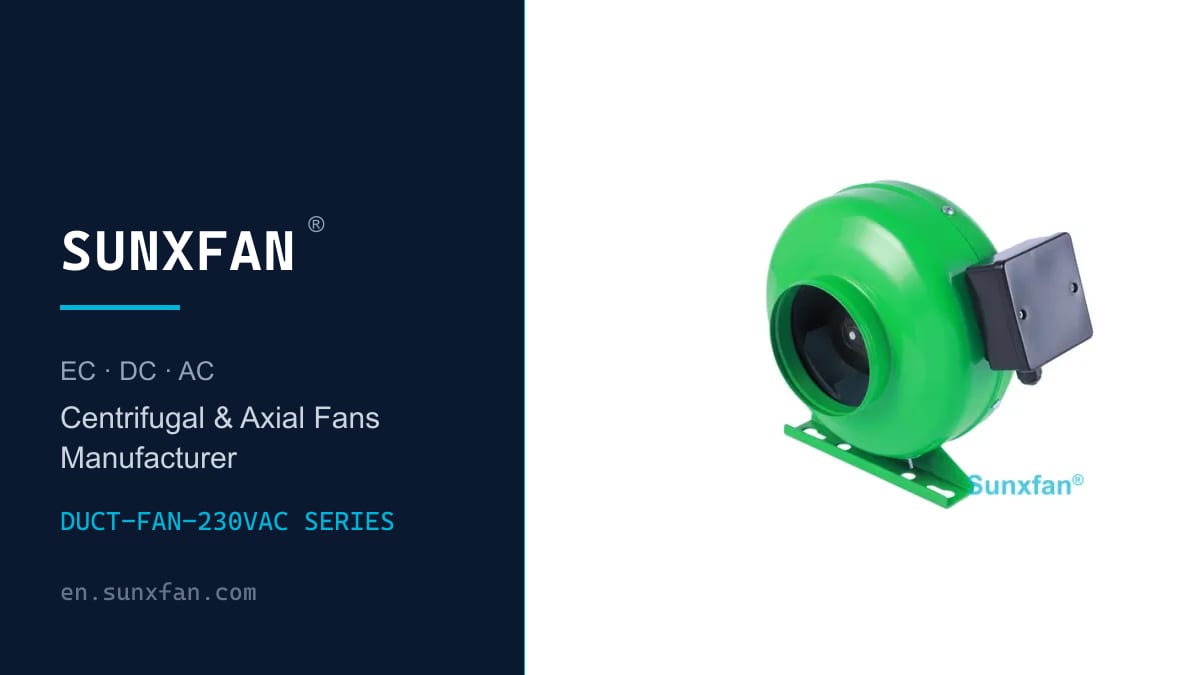
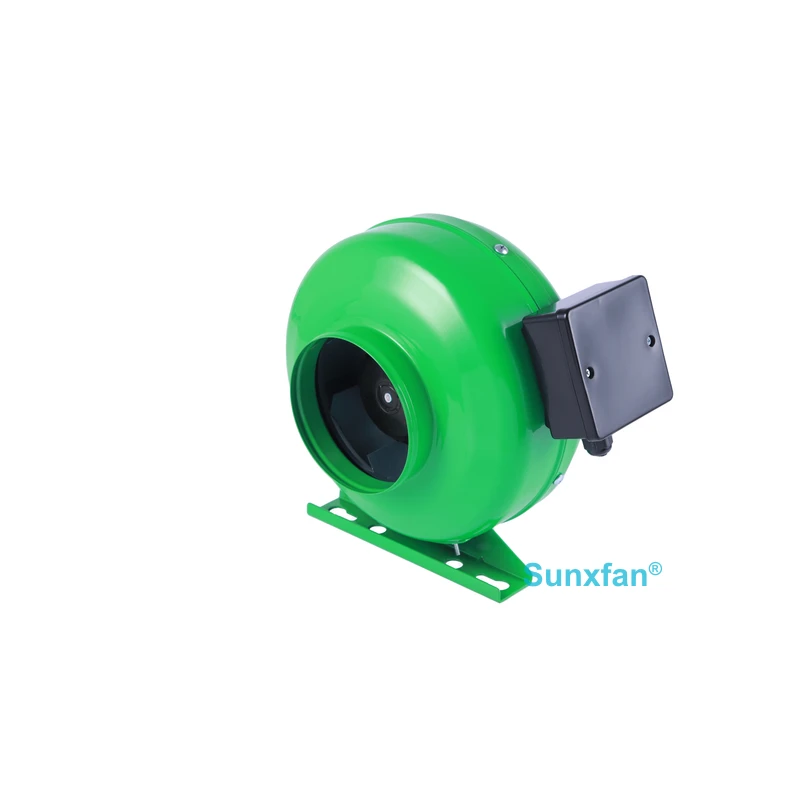
EC inline duct fans (100–315 mm spigot) that clamp into round ducting: 320–1,750 m³/h at up to 1,010 Pa. Backward-curved EC wheels develop real static pressure where cheap axial duct fans stall. 120/230 V versions, 0-10V/PWM, IP54, 58–66 dB(A).
| Model | Voltage | Power | Airflow | Noise | Speed Control | View Details |
|---|---|---|---|---|---|---|
| CF100A-E072A3-01 | 230 VAC | 85 W | 320 m³/h | 58 dB(A) | 0-10V/PWM, 0-5V, 0-6.5V, 3-speed | |
| CF125A-E072A1-01 | 120 VAC | 85 W | 380 m³/h | 60dB(A) | 0-10V/PWM, 0-5V, 0-6.5V, 3-speed | |
| CF150A-E072B3-01 | 230 VAC | 115 W | 720 m³/h | 60 dB(A) | 0-10V/PWM, 0-5V, 0-6.5V, 3-speed | |
| CF160A-E072D1-01 | 120 VAC | 115 W | 820 m³/h | 61dB(A) | 0-10V/PWM, 0-5V, 0-6.5V, 3-speed | |
| CF200A-E092D3-01 | 230 VAC | 160 W | 1080 m³/h | 63 dB(A) | 0-10V/PWM, 0-5V, 0-6.5V, 3-speed | |
| CF250A-E092D1-01 | 120 VAC | 160 W | 1205 m³/h | 64dB(A) | 0-10V/PWM, 0-5V, 0-6.5V, 3-speed | |
| CF315A-E092E3-01 | 230 VAC | 220 W | 1750 m³/h | 66 dB(A) | 0-10V/PWM, 0-5V, 0-6.5V, 3-speed |
Compare Models
Select up to 4 models to compare detailed specifications. Each parameter row is color-coded.
FAQ
CF100A-E072A3-01
We are currently using an AC Duct Fan and do not want to change the existing installation dimensions. Can we replace it with your company's EC Duct Fan?
Yes, our company's EC Duct Fan installation dimensions are compatible with those of AC Duct Fans.
Yes, our company's EC Duct Fan installation dimensions are compatible with those of AC Duct Fans. This compatibility means that when replacing or upgrading from an AC Duct Fan to an EC Duct Fan, the existing mounting holes, duct connections, and overall installation clearances can typically be reused without modification. As a result, the swap is straightforward and does not require additional adapters or rework of the ductwork or mounting structure.
CF150A-E072B3-01
Can EC Duct Fans provide wide voltage, for example, can they be used within the 110-240VAC range?
Yes, we can provide a wide-voltage version of the EC Duct Fan. Please contact our sales team.
What is EC duct fan?What “EC” means?
An EC duct fan uses an EC (electronically commutated) motor instead of a traditional AC induction motor, and is a duct-mounted ventilation fan.
An EC duct fan uses an EC (electronically commutated) motor instead of a traditional AC induction motor, and is a duct-mounted ventilation fan.
In short: it is the high-efficiency, variable-speed version of a standard duct fan.
EC = electronically commutated.
It is essentially a brushless DC motor (BLDC) with built-in power electronics. The motor can often run directly from AC mains, such as 230 V single-phase, because it internally converts AC to DC and then uses electronic commutation to drive the motor coils.
So an EC duct fan is not just a fan with a different blade — the motor and control electronics are the key difference.
CF160A-E072D1-01
Can it handle a grow room’s long duct and carbon filter?
That is exactly what the pressure budget is for.
That is exactly what the pressure budget is for. A typical carbon filter costs 100-250 Pa depending on bed depth and loading, flexible duct adds 1-3 Pa per metre, and every bend bites. The full chain — filter, duct, bends, diffuser — lands most grow rooms between 300 and 600 Pa. With 710 Pa available at 820 m³/h, the fan holds its airflow as the filter loads instead of letting the room’s air turnover decay. Run it at the lowest speed that holds the room at setpoint: the EC motor trims both noise and heat, exactly where grows are sensitive.
CF200A-E092D3-01
What to check when selecting one EC Duct Fan?
Duct diameter, airflow (m³/h or CFM), static pressure (Pa or in.
Duct diameter, airflow (m³/h or CFM), static pressure (Pa or in. WG), voltage and phase, control signal (0–10 V, PWM, Modbus, etc.), noise level (dB(A)), IP rating and ambient temperature, and certifications and local electrical codes are the key specifications to confirm when selecting a fan.
What are the main applications of EC duct fans in?
HVAC supply and exhaust systems, bathroom, toilet, and kitchen ventilation, cleanrooms and laboratories, heat recovery ventilation (HRV/ERV), grow rooms and agricultural ventilation, industrial ducted exhaust, and radon mitigation and general air movement are the applications covered by this guide.
CF315A-E092E3-01
Why do EC Duct Fans adopt EC external rotor motors + backward curved centrifugal fans?
The EC Duct Fan adopts an EC external rotor motor combined with a backward-curved centrifugal impeller, which is currently one of the most ideal combinations for duct fans in terms of balancing energy efficiency and performance. This design simultaneously achieves high static pressure, high efficiency, low noise, compact structure, wide-range speed control, and intelligent control under high-resistance duct conditions.
Why is the combination of an EC external rotor motor and a backward curved centrifugal fan the optimal solution?
The EC external rotor motor with a directly mounted backward-curved centrifugal impeller eliminates belts, gears, and couplings, achieving virtually zero transmission loss. Overall efficiency = motor efficiency × aerodynamic efficiency. Both are high, so system efficiency is naturally superior.
High static pressure + adjustable speed to adapt to duct resistance changes
Duct system resistance varies with filter clogging, damper position, and network balancing. EC motors offer stepless speed control, and backward-curved impellers remain highly efficient at high static pressures, enabling:
Constant air volume control: automatically increases speed as resistance rises to maintain constant airflow
Constant pressure control: maintains stable duct static pressure
Demand-based ventilation: reduces speed at low loads for significant energy savingsCompact and lightweight, suitable for duct installation
The external rotor motor has a short axial length, and the backward-curved centrifugal impeller can be designed in a compact form. The overall unit is small and can be installed directly into round or rectangular ducts, saving installation space.Low noise for improved comfort
EC motors are inherently low-noise, and backward-curved impellers provide smooth airflow. The combination results in overall noise levels far lower than AC forward-curved multi-blade fans, making them suitable for noise-sensitive environments such as hospitals, laboratories, data centers, and residential buildings.Intelligent control and system integration
EC motors have built-in electronic drives and can easily connect to 0–10V, Modbus, and BMS for remote monitoring, fault alarms, and energy consumption statistics. The self-power-limiting characteristic of the backward-curved impeller prevents the motor from overload and burnout even under abnormal operating conditions.Long service life, low maintenance
No carbon brushes, no belts, no mechanical commutation—long bearing life and extremely low maintenance costs. The backward-curved impeller resists dust accumulation, minimizing performance degradation over long-term operation.